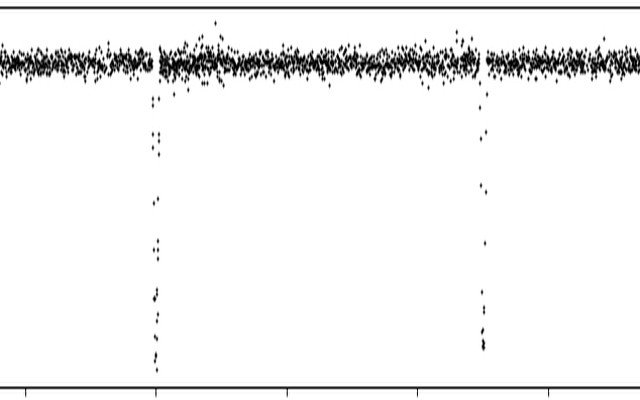
TIC 114819301
Eclipsing binaryProbably noise
Rare & notable finds
Nothing rare: all 4 checks came back clear. What was checked →
Checked, nothing found (3)
Microlensing (rogue planet?) · Exocomet-shaped dip · Type of star
Checked 2026-10-04 21:58 on NVIDIA GeForce RTX 4070, using every TESS sector of this star. All results (.json)
Notes
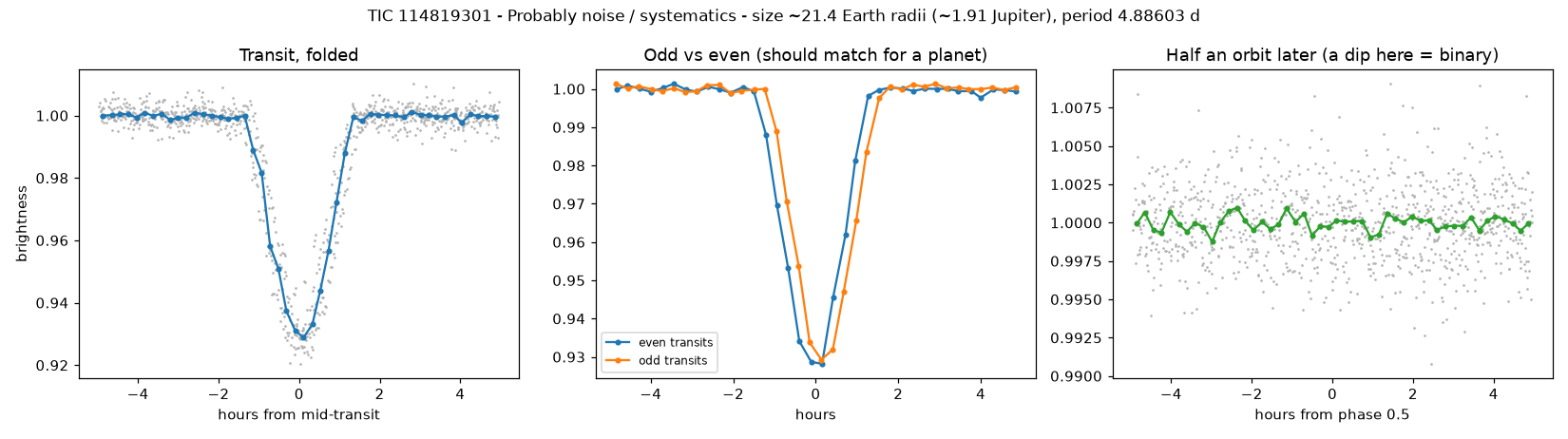
Probably noise or an instrument effect.
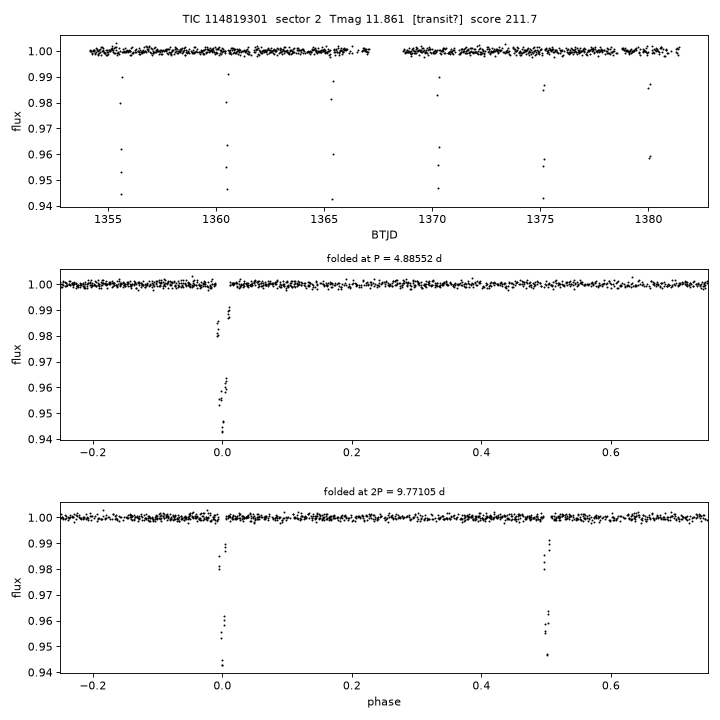
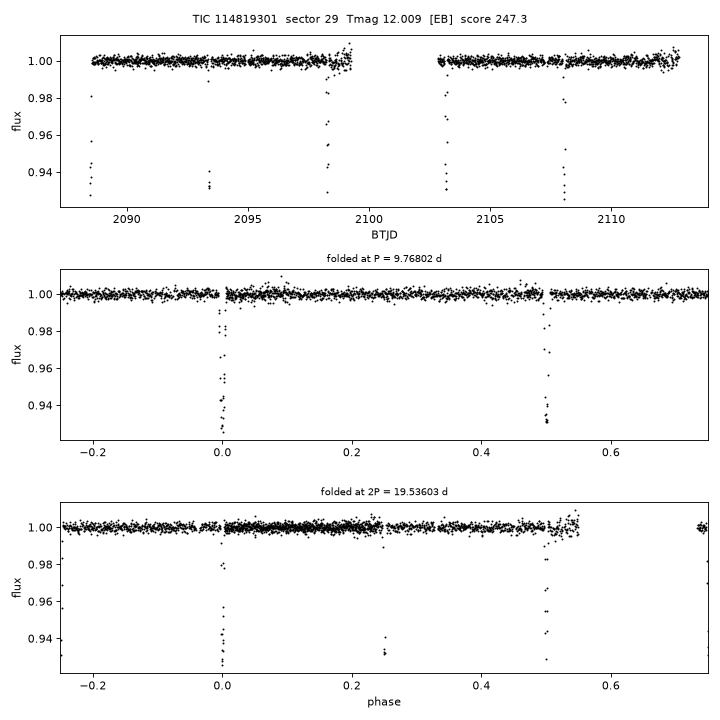
Found automatically by hunt.py in TESS sector 29 (flagged in 2 sector(s)). Detection score 247.3.
Not in VSX, ASAS-SN or ZTF variable catalogues at the time of the search; not in Gaia DR3's variable lists.
Unchecked by hand yet: verify the period, nearby stars and a wider catalogue search.
Updates:
2026-10-02 Gaia hints at a hidden companion star (RUWE 1.9)
2026-10-02 Planet check: Probably noise or an instrument effect
2026-10-02 Found by the automatic search in TESS sector 2
The signal
| Type | Eclipsing binary |
| Status | Probably noise |
| Period (days) | 9.76802 |
| Period source | hunt.py on TESS QLP sector 29 |
| Eclipse / dip depth | 6.0% |
| Amplitude | 0.6% |
| Data used | TESS sector 29 (QLP) |
Planet check
| Verdict | Probably noise or an instrument effect |
| Size if it's a planet | ~21.4 Earth radii (~1.91 Jupiter) |
The star (Gaia & TESS)
| Distance (pc) | 119 (~388 light years) |
| Temperature (Gaia) | 4,043 K |
| Size (Gaia) | 0.96 x the Sun |
| Luminosity (Gaia) | 0.17 x the Sun |
| Colour, Gaia BP-RP | 2.11 |
| RUWE (Gaia) | 1.87 - hints at a hidden companion star |
| Radial velocity (Gaia) | speed changes by 28 km/s - likely an orbiting pair |
| Gaia G mag | 12.95 |
| TESS mag | 12.01 |
Names & neighbours
| TIC ID | 114819301 |
| Gaia DR3 ID | 2366167547168965504 |
| SIMBAD name | UCAC2 24501451 [PM*] |
| Nearest known variable | none within 5' |
| RA (deg) | 2.30465 |
| Dec (deg) | -18.9139 |
| Look it up | SIMBAD · VSX · ESASky · ExoFOP |
Record
| Found by | hunt.py (automatic) |
| Date | 2026-10-02 |
| Last update | 2026-10-02 |
Where it sits among the stars
ESA Gaia colour and true brightness. Grey: every Star Log candidate. Orange: this star.
Data files
- 5_planet_check.png 107 KB
- TIC114819301_s0002.fits 79 KB
- TIC114819301_s0002.png 43 KB
- TIC114819301_s0029.fits 208 KB
- TIC114819301_s0029.png 47 KB
- lightcurve_all_sectors.csv 555 KB
- planet_check.json 5 KB
- rare_check.json 1 KB
- thumb.png 54 KB
- meta.json