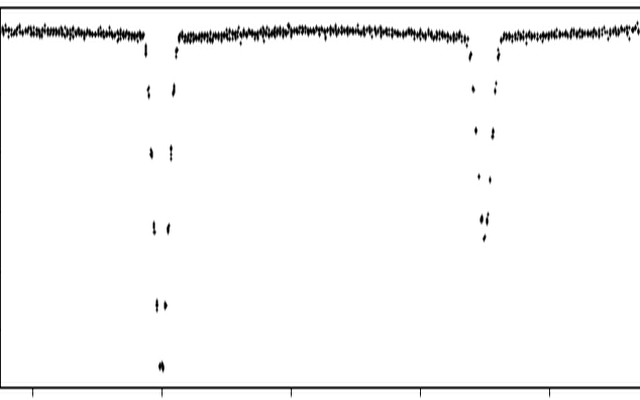
TIC 114917180
Eclipsing binaryNotable, already known
Rare & notable finds
A notable find: not unheard of, but the kind of system astronomers are glad to have more of. How these checks work →
Already known: catalogued variable star nearby: Gaia DR3 6775607850596595968 (ROT), 142" away. The rare-find check confirms what is on record - still nice, but not a new discovery.
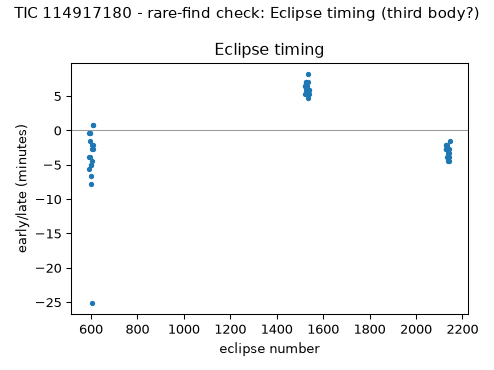
- Eclipse timing (third body?) notable
The eclipses drift early and late by 5.7 min: light taking longer or shorter to reach us as the pair is pulled around by a hidden third star (or planet), or a slowly turning eccentric orbit.
Checked, nothing found (6)
Microlensing (rogue planet?) · Exocomet-shaped dip · Eclipses changing depth · Pulsating star in an eclipsing binary · Extra dips outside the eclipses · Type of star
Checked 2026-10-12 02:44 on NVIDIA GeForce RTX 4070, using every TESS sector of this star. All results (.json)
Notes
Notable, already known: Eclipse timing (third body?) (catalogued variable star nearby: Gaia DR3 6775607850596595968 (ROT), 142" away).
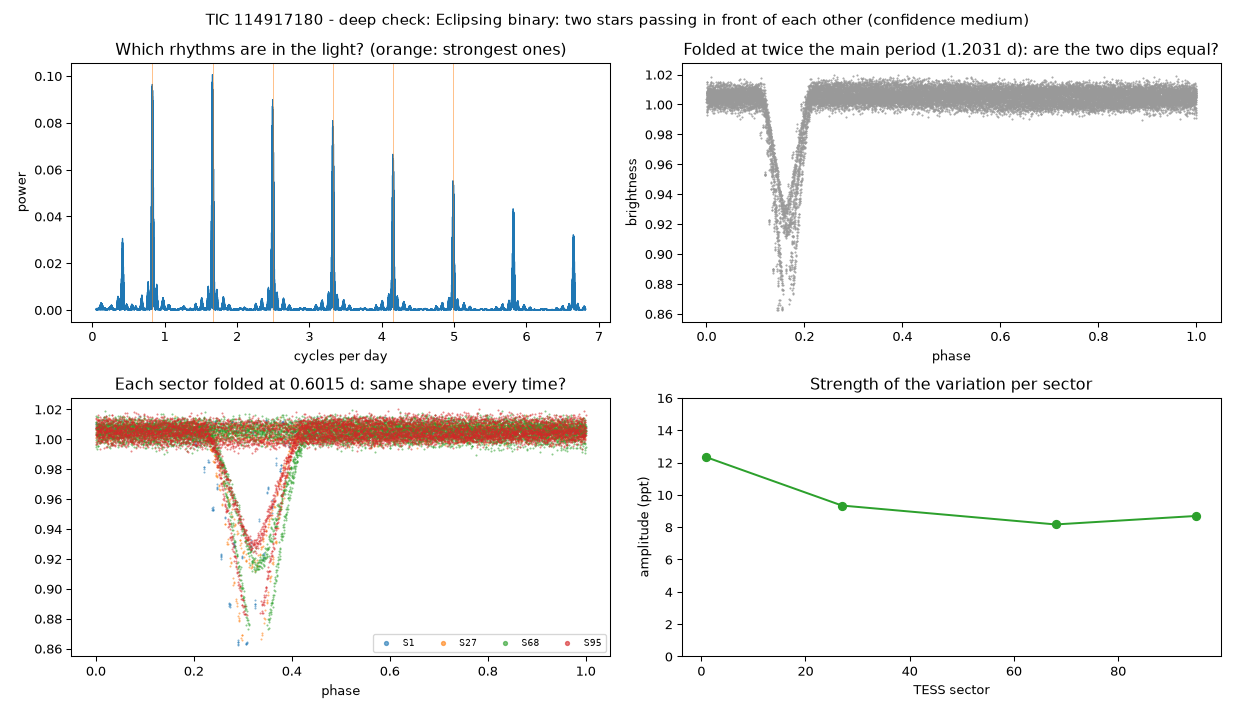
Deep check (all TESS sectors): Eclipsing binary: two stars passing in front of each other (confidence: medium). True period 1.203058 d (twice the hunt's period: two dips per orbit).
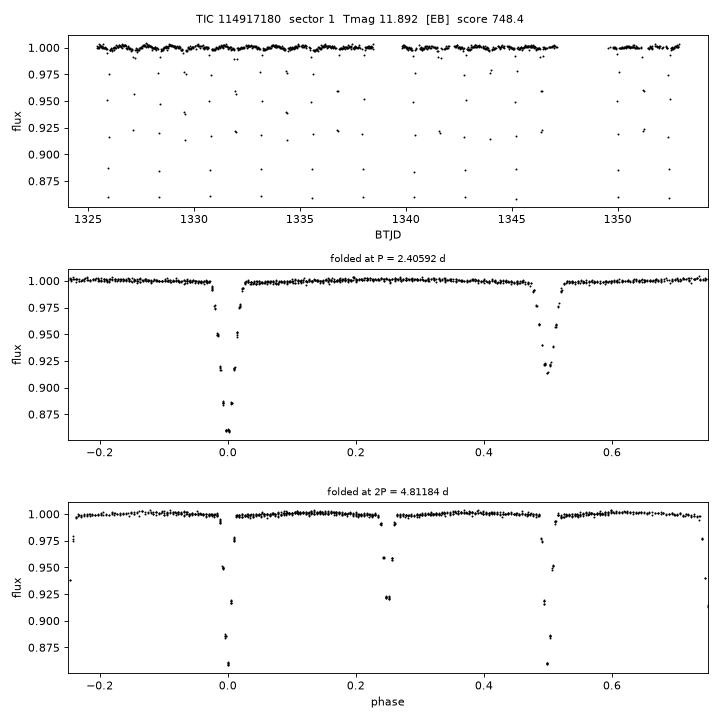
Found automatically by hunt.py in TESS sector 1 (flagged in 2 sector(s)). Detection score 748.4.
Not in VSX, ASAS-SN or ZTF variable catalogues at the time of the search; not in Gaia DR3's variable lists.
Unchecked by hand yet: verify the period, nearby stars and a wider catalogue search.
Updates:
2026-10-12 Rare-find check: Eclipse timing (third body?)
2026-10-04 Deep check of all TESS sectors: Eclipsing binary: two stars passing in front of each other (confidence: medium)
2026-10-02 Gaia hints at a hidden companion star (RUWE 1.8)
2026-10-01 Found by the automatic search in TESS sector 1
The signal
| Type | Eclipsing binary |
| Status | Notable, already known |
| Period (days) | 2.40592 |
| Period source | hunt.py on TESS QLP sector 1 |
| Eclipse / dip depth | 9.5% |
| Amplitude | 6.2% |
| Data used | TESS sector 1 (QLP) |
Deep check
| What it most likely is | Eclipsing binary: two stars passing in front of each other (confidence: medium) |
| True period | 1.203058 d (twice the hunt's period: two dips per orbit) |
Why
| |
The star (Gaia & TESS)
| Distance (pc) | 291 (~948 light years) |
| Temperature (Gaia) | 4,827 K |
| Size (Gaia) | 1.19 x the Sun |
| Mass (Gaia) | 0.85 x the Sun |
| Luminosity (Gaia) | 0.69 x the Sun |
| Colour, Gaia BP-RP | 1.12 |
| RUWE (Gaia) | 1.84 - hints at a hidden companion star |
| Radial velocity (Gaia) | speed changes by 23 km/s - likely an orbiting pair |
| Gaia G mag | 12.57 |
| TESS mag | 11.89 |
Names & neighbours
| TIC ID | 114917180 |
| Gaia DR3 ID | 6775607399623323520 |
| SIMBAD name | not in SIMBAD |
| Nearest known variable | Gaia DR3 6775607850596595968 (ROT), 142" away |
| RA (deg) | 314.877 |
| Dec (deg) | -36.4388 |
| Look it up | SIMBAD · VSX · ESASky · ExoFOP |
Record
| Found by | hunt.py (automatic) |
| Date | 2026-10-01 |
| Last update | 2026-10-12 |
Where it sits among the stars
ESA Gaia colour and true brightness. Grey: every Star Log candidate. Orange: this star.
Data files
- 10_rare_check.png 19 KB
- 9_deep_check.png 161 KB
- TIC114917180_s0001.fits 79 KB
- TIC114917180_s0001.png 42 KB
- deep_check.json 2 KB
- rare_check.json 5 KB
- thumb.png 32 KB
- meta.json