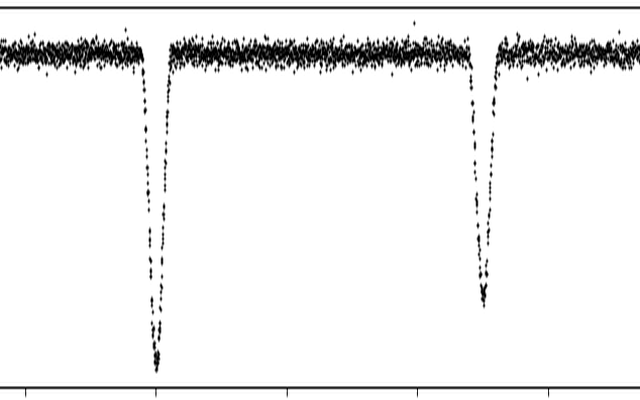
TIC 165146651
Eclipsing binaryChecked in depth
Rare & notable finds
Nothing rare: all 8 checks came back clear. What was checked →
Checked, nothing found (6)
Microlensing (rogue planet?) · Exocomet-shaped dip · Eclipse timing (third body?) · Pulsating star in an eclipsing binary · Extra dips outside the eclipses · Type of star
Checked 2026-10-12 14:19 on NVIDIA GeForce RTX 4070, using every TESS sector of this star. All results (.json)
Notes
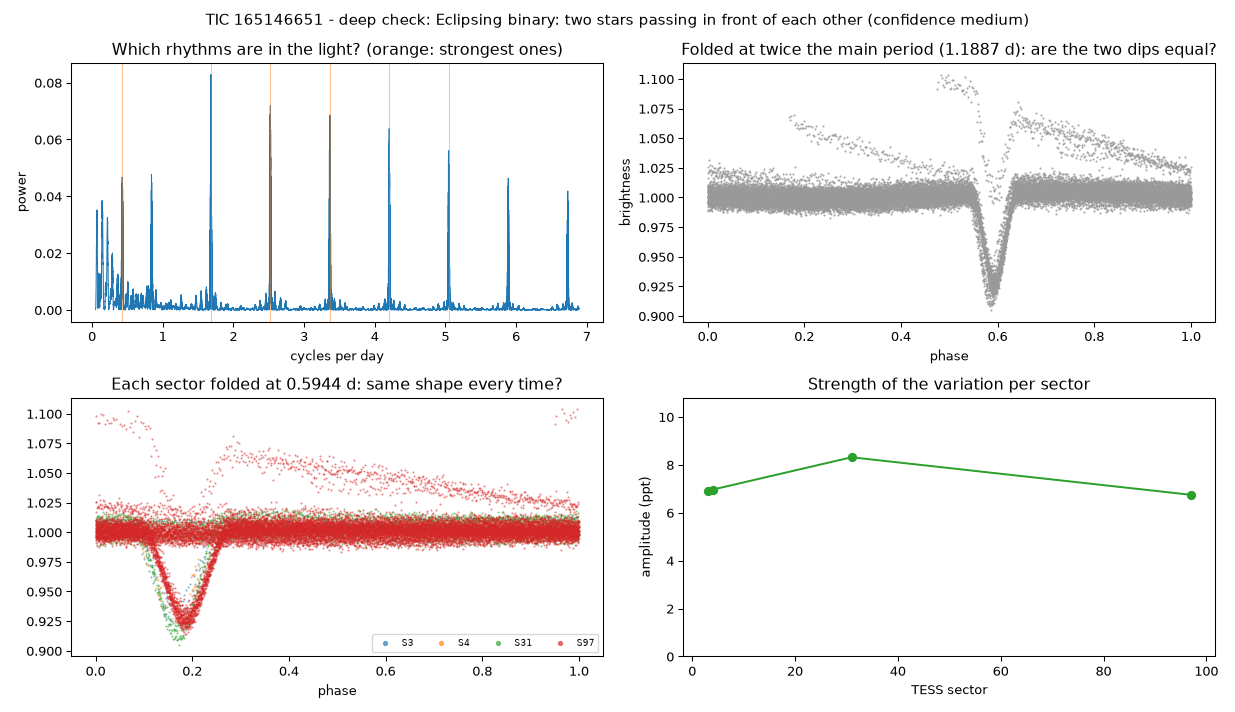
Deep check (all TESS sectors): Eclipsing binary: two stars passing in front of each other (confidence: medium). True period 1.188716 d (twice the hunt's period: two dips per orbit).
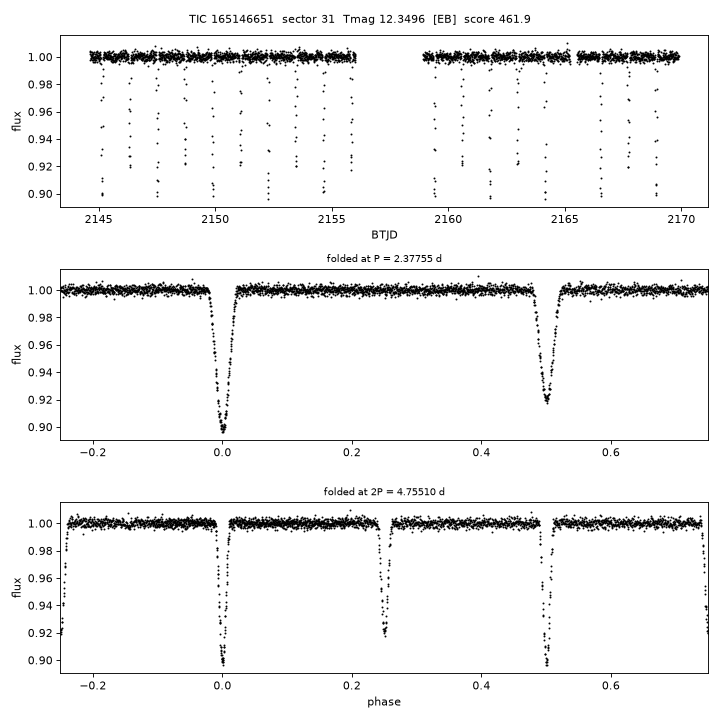
Found automatically by hunt.py in TESS sector 31 (flagged in 3 sector(s)). Detection score 461.9.
Not in VSX, ASAS-SN or ZTF variable catalogues at the time of the search; not in Gaia DR3's variable lists.
Unchecked by hand yet: verify the period, nearby stars and a wider catalogue search.
Updates:
2026-10-04 Deep check of all TESS sectors: Eclipsing binary: two stars passing in front of each other (confidence: medium)
2026-10-02 Gaia hints at a hidden companion star (RUWE 9.9)
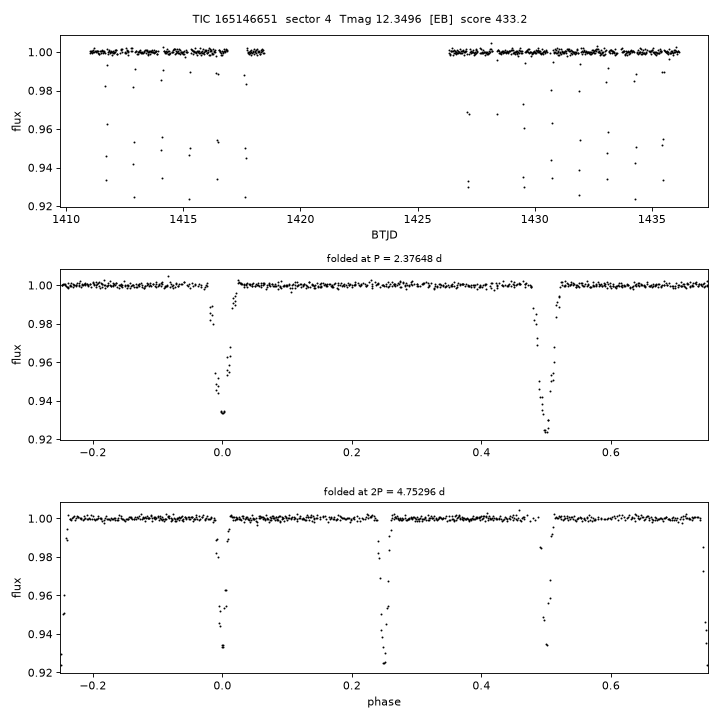
2026-10-02 Found by the automatic search in TESS sector 4
The signal
| Type | Eclipsing binary |
| Status | Checked in depth |
| Period (days) | 2.37755 |
| Period source | hunt.py on TESS QLP sector 31 |
| Eclipse / dip depth | 7.3% |
| Amplitude | 4.1% |
| Data used | TESS sector 31 (QLP) |
Deep check
| What it most likely is | Eclipsing binary: two stars passing in front of each other (confidence: medium) |
| True period | 1.188716 d (twice the hunt's period: two dips per orbit) |
Why
| |
The star (Gaia & TESS)
| Distance (pc) | 275 (~897 light years) |
| Temperature (Gaia) | 4,541 K |
| Size (Gaia) | 1.10 x the Sun |
| Mass (Gaia) | 0.85 x the Sun |
| Luminosity (Gaia) | 0.59 x the Sun |
| Colour, Gaia BP-RP | 1.36 |
| RUWE (Gaia) | 9.89 - hints at a hidden companion star |
| Radial velocity (Gaia) | speed changes by 27 km/s - likely an orbiting pair |
| Gaia G mag | 13.03 |
| TESS mag | 12.35 |
Names & neighbours
| TIC ID | 165146651 |
| Gaia DR3 ID | 5044809560147779200 |
| SIMBAD name | not in SIMBAD |
| Nearest known variable | none within 5' |
| RA (deg) | 46.829 |
| Dec (deg) | -38.8507 |
| Look it up | SIMBAD · VSX · ESASky · ExoFOP |
Record
| Found by | hunt.py (automatic) |
| Date | 2026-10-02 |
| Last update | 2026-10-04 |
Where it sits among the stars
ESA Gaia colour and true brightness. Grey: every Star Log candidate. Orange: this star.
Data files
- 9_deep_check.png 162 KB
- TIC165146651_s0004.fits 68 KB
- TIC165146651_s0004.png 39 KB
- TIC165146651_s0031.fits 200 KB
- TIC165146651_s0031.png 57 KB
- deep_check.json 2 KB
- rare_check.json 4 KB
- thumb.png 59 KB
- meta.json