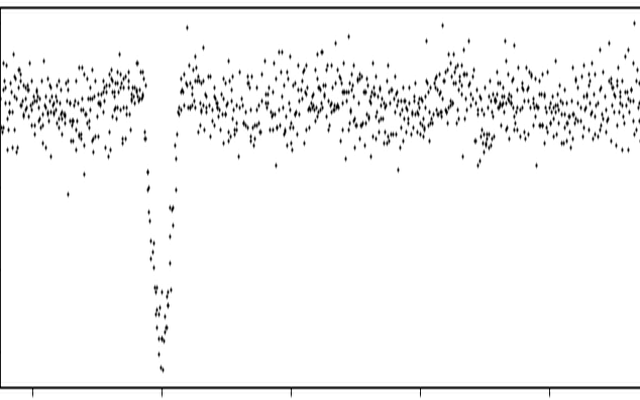
TIC 166175613
Transit candidateRare, already known
Rare & notable finds
Something genuinely unusual turned up. Treat it as a lead: every one of these has ordinary explanations too, listed with each. How these checks work →
Already known: in SIMBAD as TYC 4172-1431-1 (*); catalogued variable star nearby: Gaia DR3 1666591076289064192 (ROT), 206" away. The rare-find check confirms what is on record - still nice, but not a new discovery.
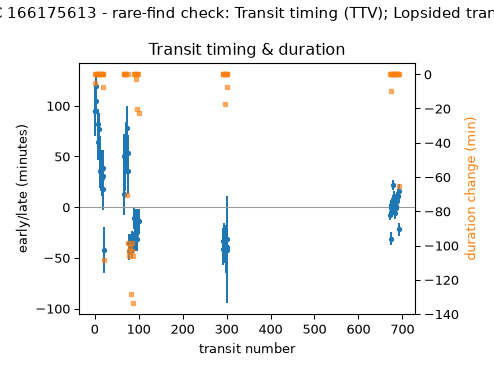
- Transit timing (TTV) significant
The transits arrive early or late by 41.7 min (typical error 11.9 min) repeating every ~182.4 orbits: something is tugging on the planet - another planet, or a moon. - Lopsided transit hint
The start of the transit is deeper than the end: a dust tail (disintegrating planet), rings, a fast-spinning star, or a blend.
Checked, nothing found (6)
Microlensing (rogue planet?) · Exocomet-shaped dip · Habitable zone & size · Transit duration (TDV) · Changing transit depth · Type of star
Checked 2026-10-11 17:09 on NVIDIA GeForce RTX 4070, using every TESS sector of this star. All results (.json)
Notes
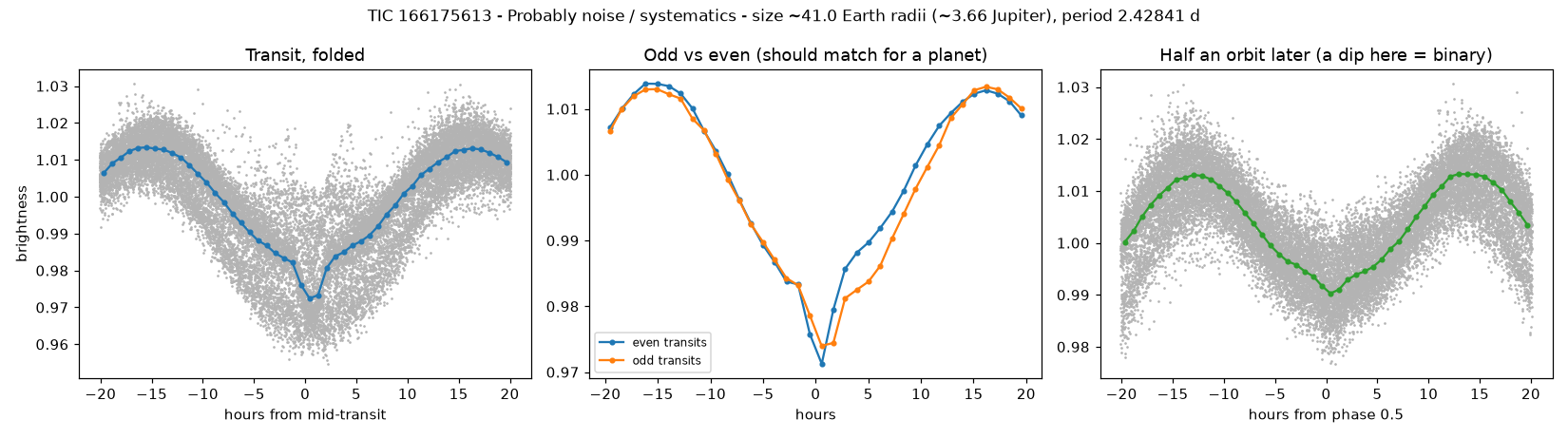
Probably noise or an instrument effect.
Rare, already known: Transit timing (TTV); Lopsided transit (in SIMBAD as TYC 4172-1431-1 (*); catalogued variable star nearby: Gaia DR3 1666591076289064192 (ROT), 206" away).
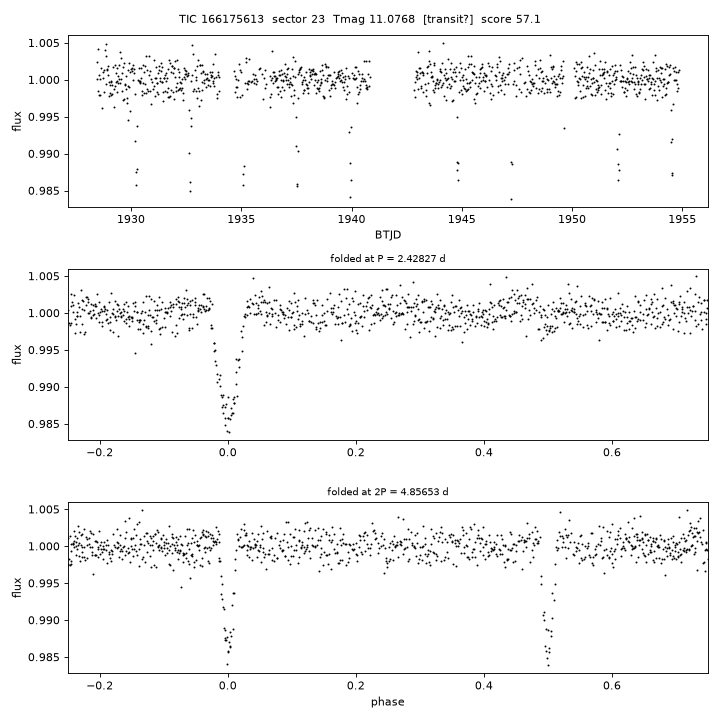
Found automatically by hunt.py in TESS sector 23 (flagged in 5 sector(s)). Detection score 57.1.
Not in VSX, ASAS-SN or ZTF variable catalogues at the time of the search; not in Gaia DR3's variable lists.
Unchecked by hand yet: verify the period, nearby stars and a wider catalogue search.
Updates:
2026-10-11 Planet check: Probably noise or an instrument effect
2026-10-11 Rare-find check: Transit timing (TTV); Lopsided transit
2026-10-11 Found by the automatic search in TESS sector 23
The signal
| Type | Transit candidate |
| Status | Rare, already known |
| Period (days) | 2.42827 |
| Period source | hunt.py on TESS QLP sector 23 |
| Eclipse / dip depth | 1.1% |
| Amplitude | 0.6% |
| Data used | TESS sector 23 (QLP) |
Planet check
| Verdict | Probably noise or an instrument effect |
| Size if it's a planet | ~41.0 Earth radii (~3.66 Jupiter) - too big for a planet |
The star (Gaia & TESS)
| Distance (pc) | 1,049 (~3,422 light years) |
| Temperature (Gaia) | 9,515 K |
| Size (Gaia) | 2.53 x the Sun |
| Mass (Gaia) | 2.41 x the Sun |
| Luminosity (Gaia) | 47.39 x the Sun |
| Colour, Gaia BP-RP | 0.23 |
| RUWE (Gaia) | 0.92 - fits a single star |
| Radial velocity (Gaia) | speed changes by 57 km/s - likely an orbiting pair |
| Gaia G mag | 11.18 |
| TESS mag | 11.08 |
Names & neighbours
| TIC ID | 166175613 |
| Gaia DR3 ID | 1666966559509957376 |
| SIMBAD name | TYC 4172-1431-1 [*] |
| Nearest known variable | Gaia DR3 1666591076289064192 (ROT), 206" away |
| RA (deg) | 217.06 |
| Dec (deg) | 62.405 |
| Look it up | SIMBAD · VSX · ESASky · ExoFOP |
Record
| Found by | hunt.py (automatic) |
| Date | 2026-10-11 |
| Last update | 2026-10-11 |
Where it sits among the stars
ESA Gaia colour and true brightness. Grey: every Star Log candidate. Orange: this star.
Data files
- 10_rare_check.png 28 KB
- 5_planet_check.png 175 KB
- TIC166175613_s0023.fits 79 KB
- TIC166175613_s0023.png 46 KB
- lightcurve_all_sectors.csv 2 MB
- planet_check.json 4 KB
- rare_check.json 5 KB
- thumb.png 73 KB
- meta.json