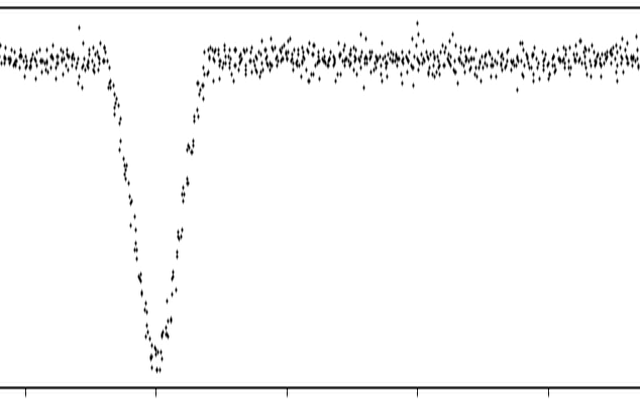
TIC 218886767
Transit candidateNotable, already known
Rare & notable finds
A notable find: not unheard of, but the kind of system astronomers are glad to have more of. How these checks work →
Already known: in SIMBAD as UCAC2 22892347 (SB*); the catalogued variable Gaia DR3 5700190886277233152 (E, 32" away) has the same period - its light leaks into TESS's big pixels; same period as the known variable Gaia DR3 5700190886277233152. The rare-find check confirms what is on record - still nice, but not a new discovery.
- Pulsating star in an eclipsing binary notable
Besides the eclipses, one star pulsates 5.9 times a day (893 ppm): a delta Scuti-type pulsator in an eclipsing binary. The eclipses give its mass and size, the pulsations its inside - a few hundred such systems are known. - Transits of a giant star notable
Gaia places this star among the giants: planets transiting giants are rare, and a big star makes even a large planet's dip tiny.
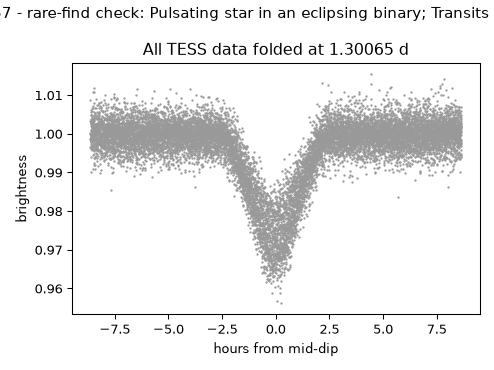
Checked, nothing found (5)
Microlensing (rogue planet?) · Exocomet-shaped dip · Eclipse timing (third body?) · Eclipses changing depth · Extra dips outside the eclipses
Checked 2026-10-04 21:55 on NVIDIA GeForce RTX 4070, using every TESS sector of this star. All results (.json)
Notes
The signal
| Type | Transit candidate |
| Status | Notable, already known |
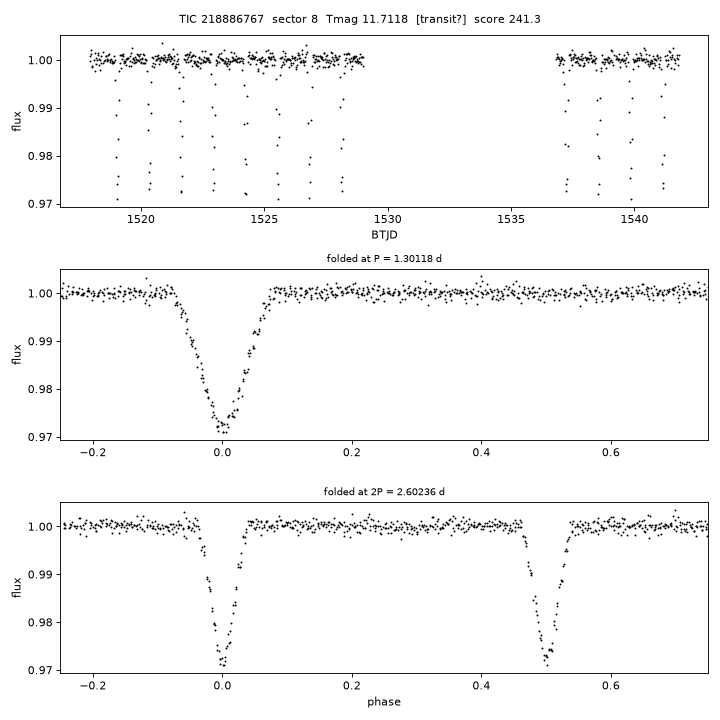
| Period (days) | 1.30118 |
| Period source | hunt.py on TESS QLP sector 8 |
| Eclipse / dip depth | 1.8% |
| Amplitude | 2.2% |
| Data used | TESS sector 8 (QLP) |
Planet check
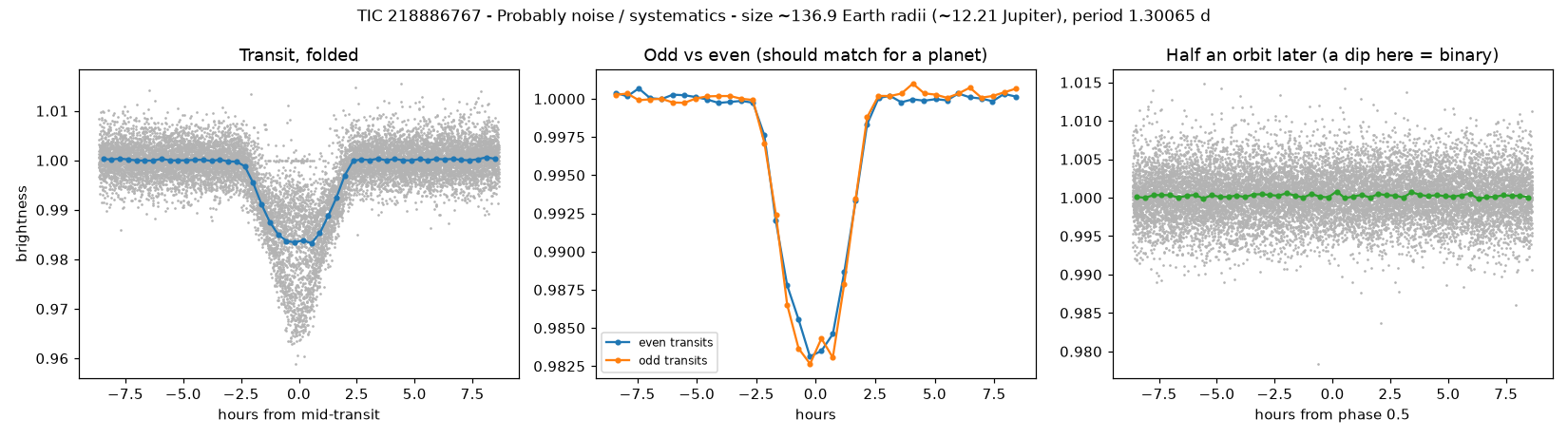
| Verdict | Probably noise or an instrument effect |
| Size if it's a planet | ~136.9 Earth radii (~12.21 Jupiter) - too big for a planet |
The star (Gaia & TESS)
| Distance (pc) | 2,110 (~6,883 light years) |
| Colour, Gaia BP-RP | 1.13 |
| RUWE (Gaia) | 1.38 - fits a single star |
| Radial velocity (Gaia) | speed changes by 24 km/s - likely an orbiting pair |
| Gaia G mag | 12.29 |
| TESS mag | 11.71 |
Names & neighbours
| TIC ID | 218886767 |
| Gaia DR3 ID | 5700190881974522752 |
| SIMBAD name | UCAC2 22892347 [SB*], 1.6" away |
| Nearest known variable | Gaia DR3 5700190886277233152 (E, P = 1.3006 d), 32" away (same period!) |
| RA (deg) | 124.687 |
| Dec (deg) | -22.1622 |
| Look it up | SIMBAD · VSX · ESASky · ExoFOP |
Record
| Found by | hunt.py (automatic) |
| Date | 2026-10-03 |
| Last update | 2026-10-04 |
Where it sits among the stars
ESA Gaia colour and true brightness. Grey: every Star Log candidate. Orange: this star.
Data files
- 10_rare_check.png 44 KB
- 5_planet_check.png 155 KB
- TIC218886767_s0008.fits 62 KB
- TIC218886767_s0008.png 38 KB
- lightcurve_all_sectors.csv 1 MB
- planet_check.json 4 KB
- rare_check.json 6 KB
- thumb.png 47 KB
- meta.json