TIC 231824094
Transit candidateProbably noise
Notes
The signal
| Type | Transit candidate |
| Status | Probably noise |
| Period (days) | 1.2986394 |
| Period source | eclipse fit to TESS sectors [4, 5, 6, 7, 32, 33, 34, 67, 87, 95, 98] |
| Eclipse / dip depth | 4.9% |
| Amplitude | 4.1% |
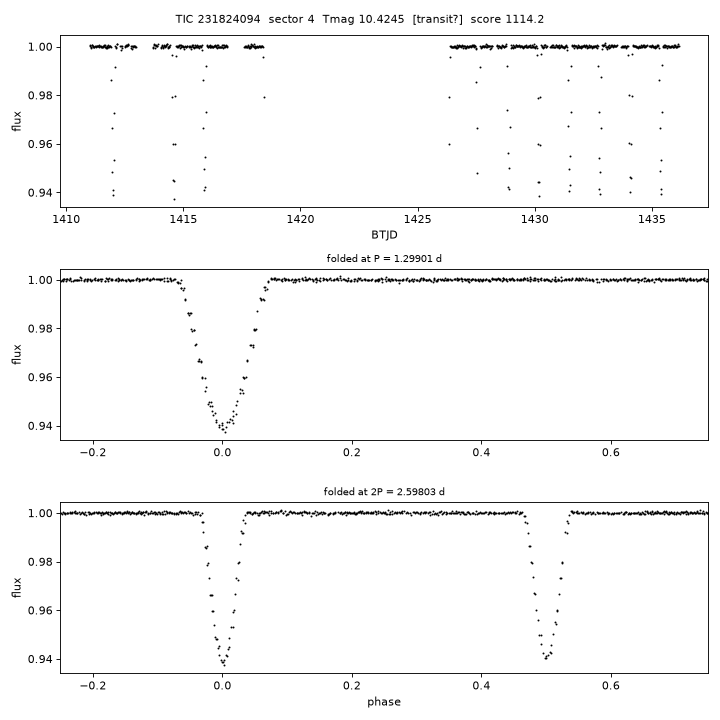
| Data used | TESS sector 4 (QLP) |
Planet check
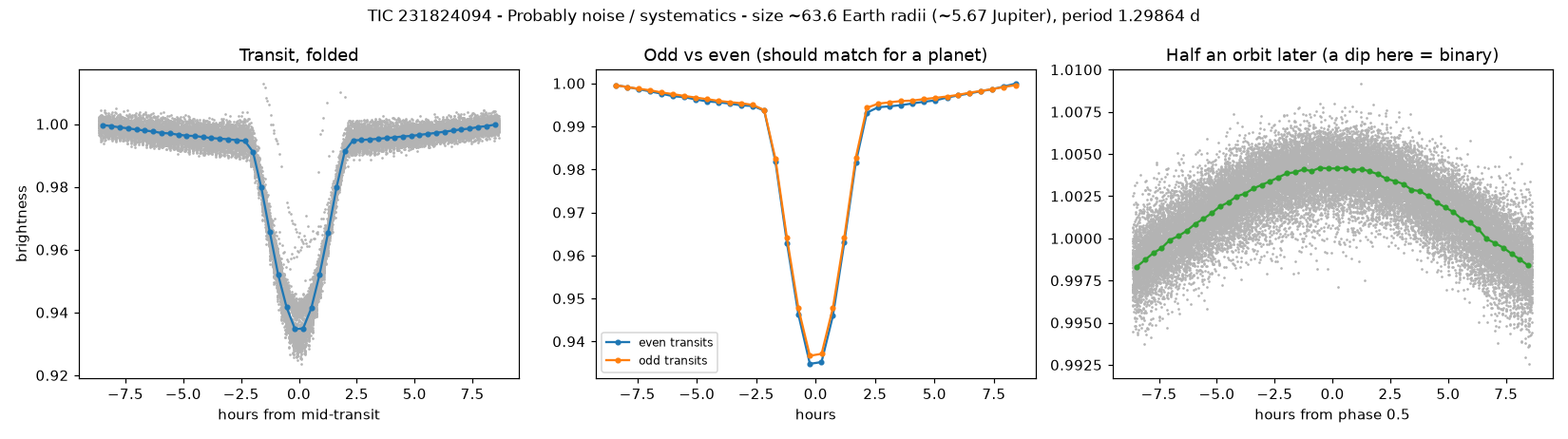
| Verdict | Probably noise or an instrument effect |
| Size if it's a planet | ~63.6 Earth radii (~5.67 Jupiter) - too big for a planet |
The star (Gaia & TESS)
| Distance (pc) | 491 (~1,600 light years) |
| Temperature (Gaia) | 6,143 K |
| Size (Gaia) | 2.61 x the Sun |
| Mass (Gaia) | 1.55 x the Sun |
| Luminosity (Gaia) | 8.72 x the Sun |
| Colour, Gaia BP-RP | 0.67 |
| RUWE (Gaia) | 0.81 - fits a single star |
| Gaia G mag | 10.78 |
| TESS mag | 10.42 |
Names & neighbours
| TIC ID | 231824094 |
| Gaia DR3 ID | 4792768922030096512 |
| SIMBAD name | CD-51 1617 [*] |
| Nearest known variable | Gaia DR3 4792768475353455488 (ROT), 272" away |
| RA (deg) | 86.5545 |
| Dec (deg) | -51.1865 |
| Look it up | SIMBAD · VSX · ESASky · ExoFOP |
Record
| Found by | hunt.py (automatic) |
| Date | 2026-10-02 |
| Last update | 2026-10-02 |
✦ Artist's impression
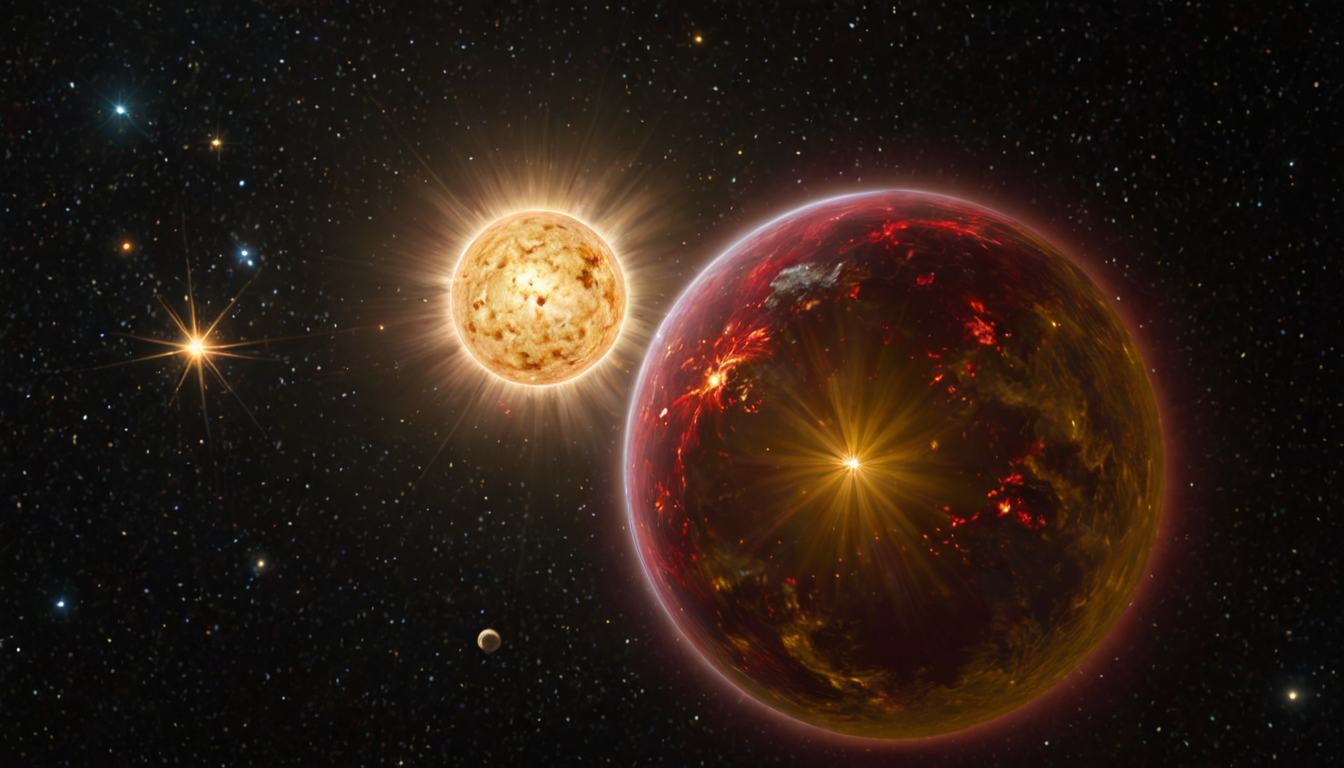
What this picture shows
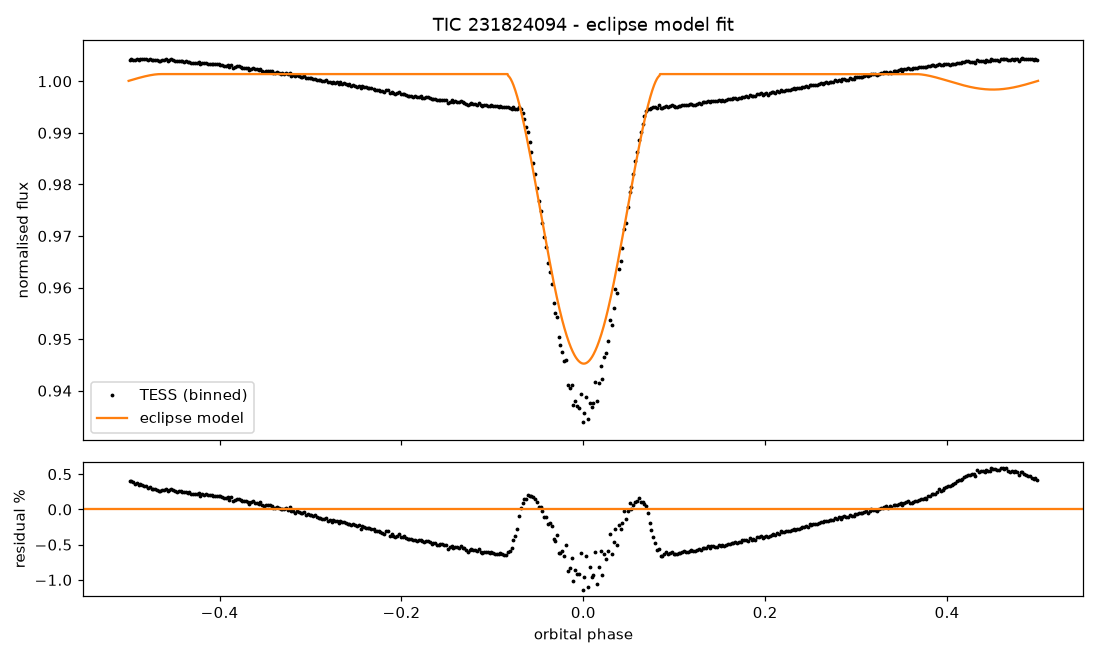
Artist's impression of an UNCONFIRMED candidate, based on its measured data. Two stars of about 6,100 K and 3,100 K (2.6 and 1.6 times the Sun's radius, ~1.1 and ~0.6 solar masses) orbit each other every 31.2 hours, 4.2 million km apart (the Sun-Mercury distance is 58 million km). We see the orbit at 56 degrees (90 = exactly edge-on), close enough to edge-on that they eclipse each other. Sizes, separation, tilt and colours come from fitting the TESS eclipses (see the model-fit plot) plus Gaia's temperature; masses assume normal main-sequence stars. The painted look, surface detail and background were added by a locally run image AI; the stars' sizes, colours and spacing follow the measured data. The secondary eclipse arrives 94 minutes earlier than half an orbit after the primary, a sign of a slightly oval (eccentric) orbit: e*cos(omega) = -0.0785.
How it was made
Painted by an image AI (DreamShaper XL, a Stable Diffusion XL model) running locally on a home PC, over a 3D layout built from the measured data. No cloud services.
Where it sits among the stars
ESA Gaia colour and true brightness. Grey: every Star Log candidate. Orange: this star.
Data files
- 0_illustration.png 1 MB
- 4_eclipse_model.png 49 KB
- 5_planet_check.png 130 KB
- TIC231824094_s0004.fits 68 KB
- TIC231824094_s0004.png 37 KB
- lightcurve_all_sectors.csv 2 MB
- model.json 767 B
- planet_check.json 4 KB
- thumb.png 30 KB
- meta.json