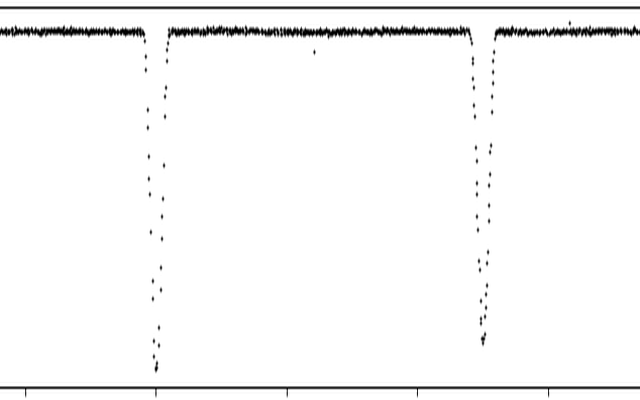
TIC 238870367
Eclipsing binaryNotable, already known
Rare & notable finds
A notable find: not unheard of, but the kind of system astronomers are glad to have more of. How these checks work →
Already known: in SIMBAD as UCAC4 080-003346 (*); catalogued variable star nearby: ASASSN-V J023342.26-735621.6 (VAR), 285" away. The rare-find check confirms what is on record - still nice, but not a new discovery.
- Superflare notable
A flare releasing roughly 1.5e+35 erg (rough, from TESS's band) on a Sun-like star - a 'superflare', more than 10x the biggest flare ever seen on the Sun.
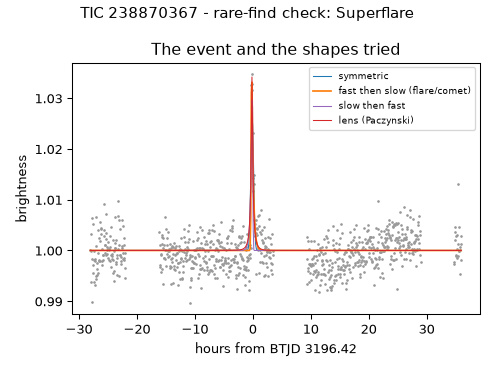
Checked, nothing found (7)
Microlensing (rogue planet?) · Exocomet-shaped dip · Eclipse timing (third body?) · Eclipses changing depth · Pulsating star in an eclipsing binary · Extra dips outside the eclipses · Type of star
Checked 2026-10-11 18:26 on NVIDIA GeForce RTX 4070, using every TESS sector of this star. All results (.json)
Notes
The signal
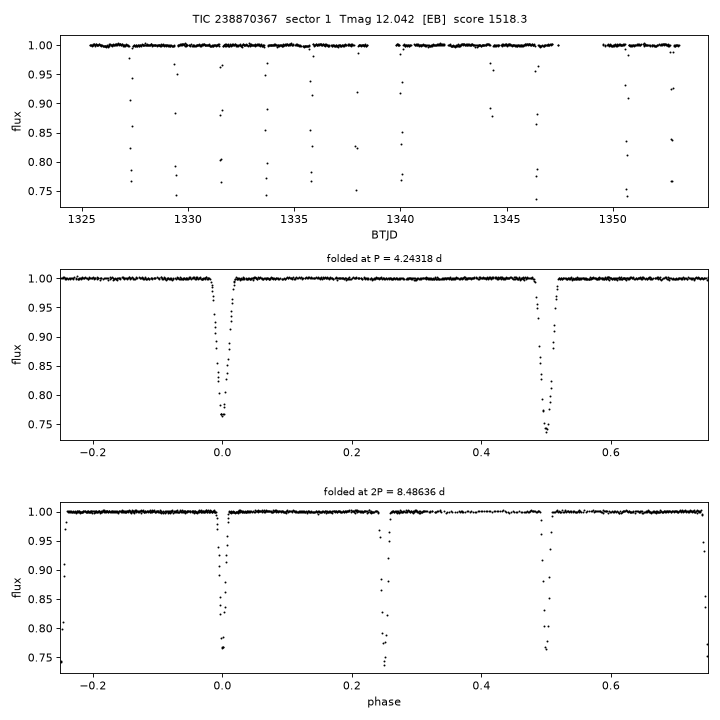
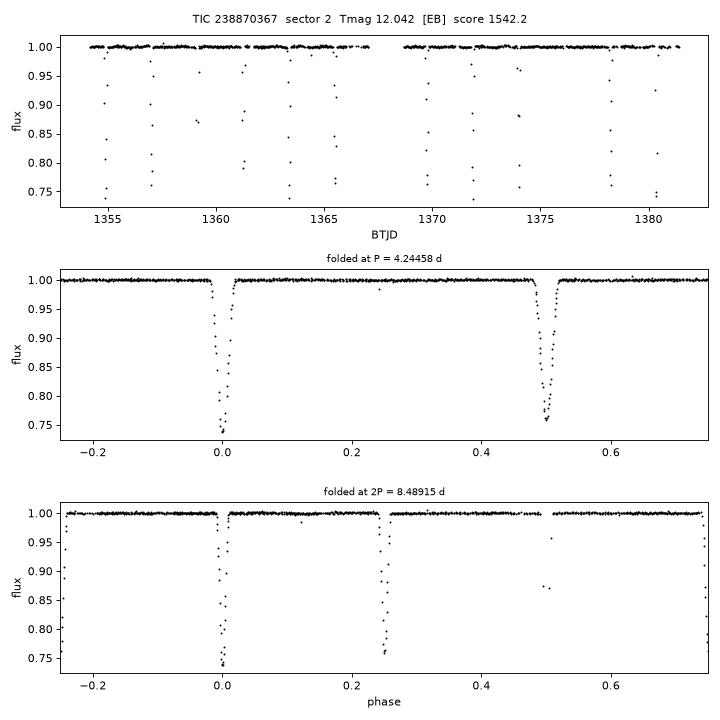
| Type | Eclipsing binary |
| Status | Notable, already known |
| Period (days) | 4.24458 |
| Period source | hunt.py on TESS QLP sector 2 |
| Eclipse / dip depth | 18.1% |
| Amplitude | 6.1% |
| Data used | TESS sector 2 (QLP) |
Deep check
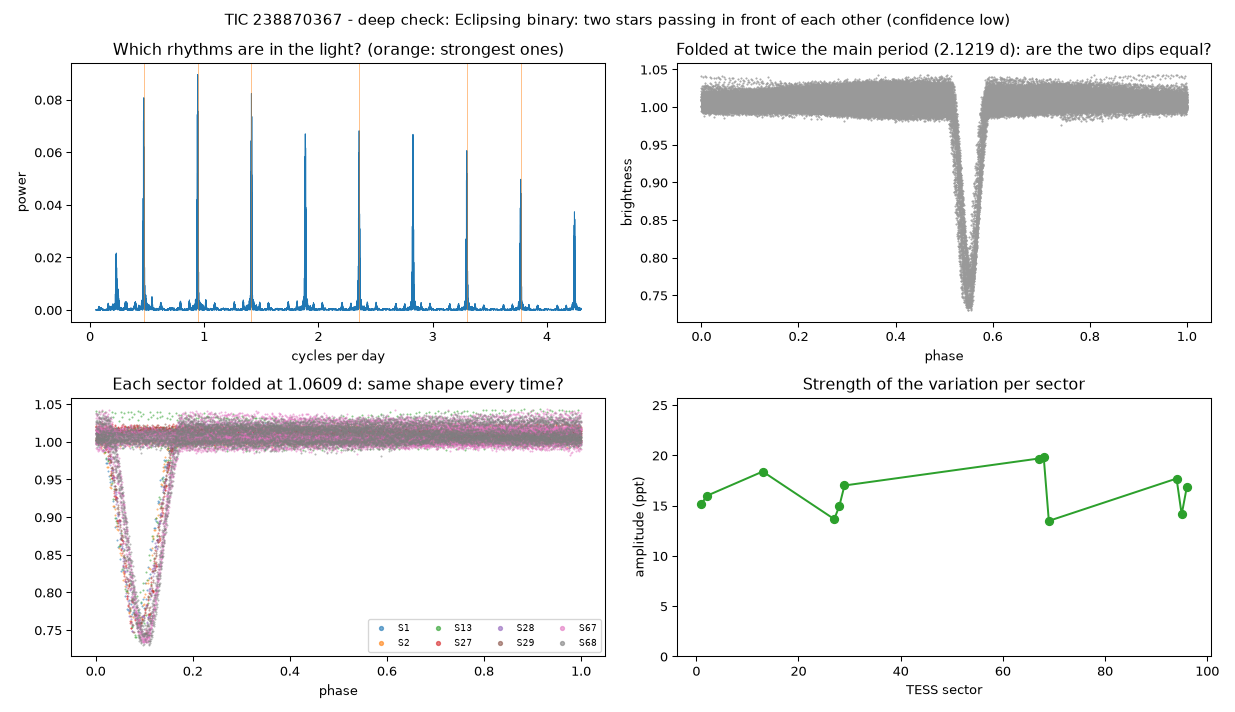
| What it most likely is | Eclipsing binary: two stars passing in front of each other (confidence: low) |
| True period | 2.121859 d (twice the hunt's period: two dips per orbit) |
Why
| |
The star (Gaia & TESS)
| Distance (pc) | 323 (~1,055 light years) |
| Temperature (Gaia) | 5,008 K |
| Size (Gaia) | 1.18 x the Sun |
| Mass (Gaia) | 0.87 x the Sun |
| Luminosity (Gaia) | 0.79 x the Sun |
| Colour, Gaia BP-RP | 1.12 |
| RUWE (Gaia) | 1.04 - fits a single star |
| Radial velocity (Gaia) | speed changes by 216 km/s - likely an orbiting pair |
| Gaia G mag | 12.70 |
| TESS mag | 12.04 |
Names & neighbours
| TIC ID | 238870367 |
| Gaia DR3 ID | 4643431431678594560 |
| SIMBAD name | UCAC4 080-003346 [*] |
| Nearest known variable | ASASSN-V J023342.26-735621.6 (VAR), 285" away |
| RA (deg) | 38.279 |
| Dec (deg) | -74.0074 |
| Look it up | SIMBAD · VSX · ESASky · ExoFOP |
Record
| Found by | hunt.py (automatic) |
| Date | 2026-10-01 |
| Last update | 2026-10-11 |
Where it sits among the stars
ESA Gaia colour and true brightness. Grey: every Star Log candidate. Orange: this star.
Data files
- 10_rare_check.png 31 KB
- 9_deep_check.png 155 KB
- TIC238870367_s0001.fits 79 KB
- TIC238870367_s0001.png 40 KB
- TIC238870367_s0002.fits 79 KB
- TIC238870367_s0002.png 40 KB
- deep_check.json 3 KB
- rare_check.json 6 KB
- thumb.png 32 KB
- meta.json