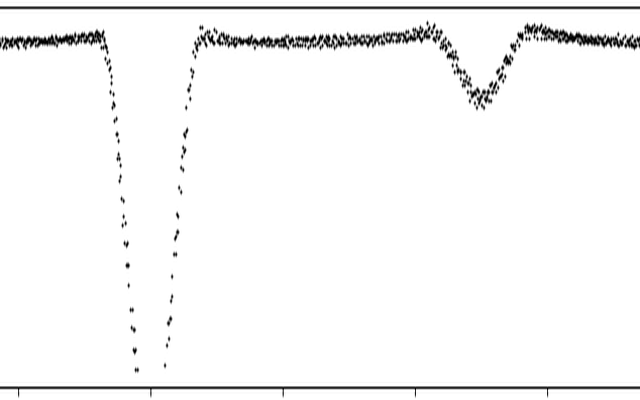
TIC 287351969
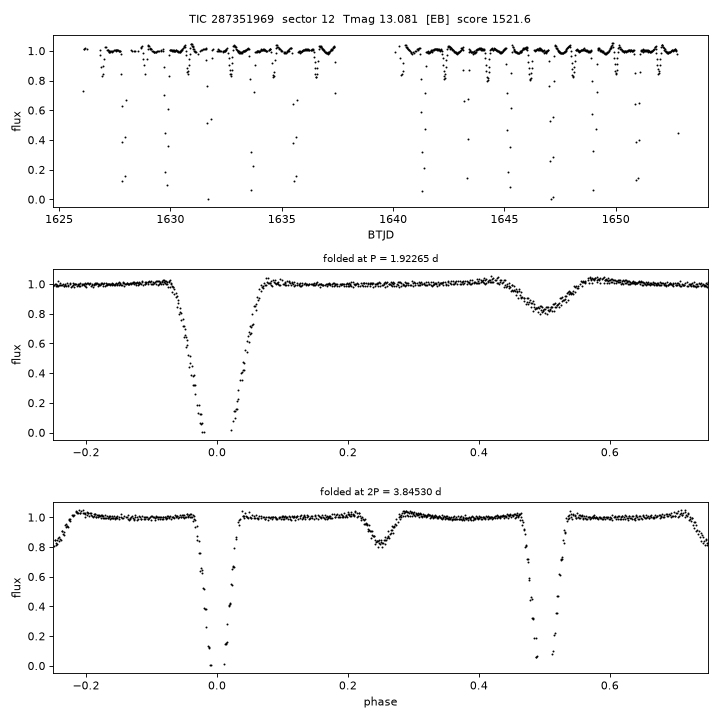
Eclipsing binaryNotable, already known
Rare & notable finds
A notable find: not unheard of, but the kind of system astronomers are glad to have more of. How these checks work →
Already known: the catalogued variable AB Vol (EA, 39" away) has the same period - its light leaks into TESS's big pixels; same period as the known variable AB Vol. The rare-find check confirms what is on record - still nice, but not a new discovery.
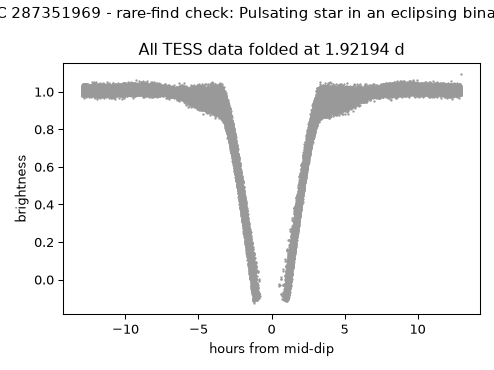
- Pulsating star in an eclipsing binary notable
Besides the eclipses, one star pulsates 38.1 times a day (4599 ppm): a delta Scuti-type pulsator in an eclipsing binary. The eclipses give its mass and size, the pulsations its inside - a few hundred such systems are known.
Checked, nothing found (9)
Microlensing (rogue planet?) · Exocomet-shaped dip · Eclipse timing (third body?) · Eccentric eclipsing binary · Eclipses changing depth · Extra dips outside the eclipses · Heartbeat star · Self-lensing binary · Type of star
Checked 2026-10-11 18:34 on NVIDIA GeForce RTX 4070, using every TESS sector of this star. All results (.json)
Notes
The signal
| Type | Eclipsing binary |
| Status | Notable, already known |
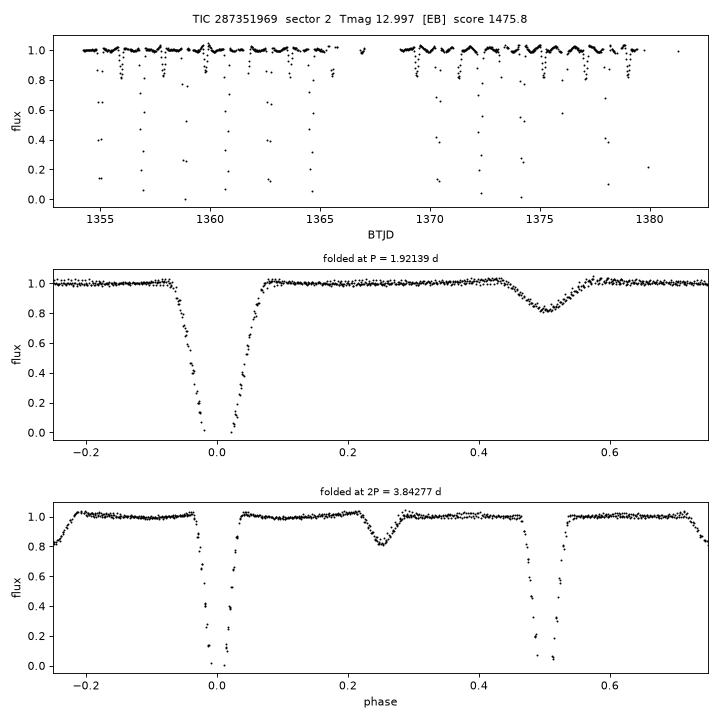
| Period (days) | 1.92265 |
| Period source | hunt.py on TESS QLP sector 12 |
| Eclipse / dip depth | 72.6% |
| Amplitude | 39.4% |
| Data used | TESS sector 12 (QLP) |
Deep check
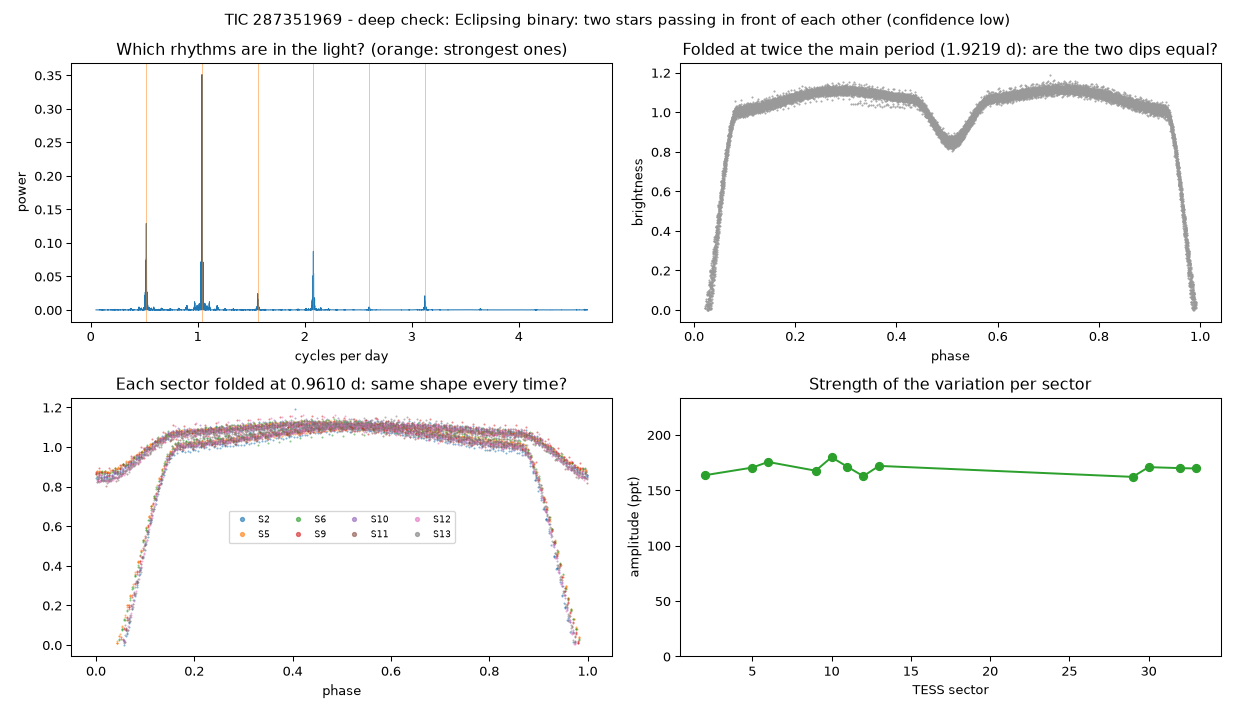
| What it most likely is | Eclipsing binary: two stars passing in front of each other (confidence: low) |
| True period | 1.921937 d (twice the hunt's period: two dips per orbit) |
Why
| |
The star (Gaia & TESS)
| Distance (pc) | 822 (~2,680 light years) |
| Temperature (Gaia) | 5,647 K |
| Size (Gaia) | 1.57 x the Sun |
| Mass (Gaia) | 1.01 x the Sun |
| Luminosity (Gaia) | 2.24 x the Sun |
| Colour, Gaia BP-RP | 0.92 |
| RUWE (Gaia) | 3.86 - hints at a hidden companion star |
| Gaia G mag | 13.57 |
| TESS mag | 13.08 |
Names & neighbours
| TIC ID | 287351969 |
| Gaia DR3 ID | 5221121403623710976 |
| SIMBAD name | not in SIMBAD |
| Nearest known variable | AB Vol (EA, P = 1.9219 d), 39" away (same period!) |
| RA (deg) | 122.659 |
| Dec (deg) | -72.5373 |
| Look it up | SIMBAD · VSX · ESASky · ExoFOP |
Record
| Found by | hunt.py (automatic) |
| Date | 2026-10-02 |
| Last update | 2026-10-11 |
Where it sits among the stars
ESA Gaia colour and true brightness. Grey: every Star Log candidate. Orange: this star.
Data files
- 10_rare_check.png 23 KB
- 9_deep_check.png 120 KB
- TIC287351969_s0002.fits 79 KB
- TIC287351969_s0002.png 41 KB
- TIC287351969_s0012.fits 82 KB
- TIC287351969_s0012.png 42 KB
- deep_check.json 3 KB
- rare_check.json 11 KB
- thumb.png 38 KB
- meta.json