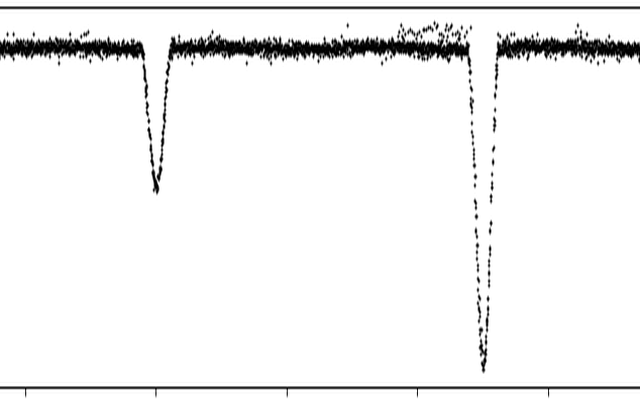
TIC 314830797
Pulsating starRare, already known
Rare & notable finds
Something genuinely unusual turned up. Treat it as a lead: every one of these has ordinary explanations too, listed with each. How these checks work →
Already known: in SIMBAD as UCAC4 063-002524 (PM*). The rare-find check confirms what is on record - still nice, but not a new discovery.
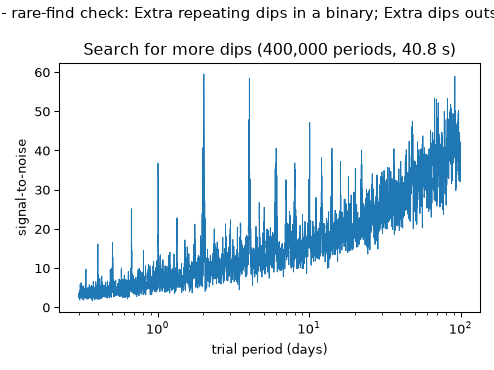
- Extra repeating dips in a binary significant
Another set of dips every 1.9866 days (2170 ppm, 61 seen, SNR 14.9). Its period is close to a 2:1 ratio with the known one (orbital resonance). - Extra dips outside the eclipses hint
1 dip(s) that don't belong to the eclipses (at BTJD 4002.76): a planet orbiting both stars (circumbinary, like Kepler-16b) makes dips at irregular times, or a third star.
Checked, nothing found (10)
Microlensing (rogue planet?) · Superflare · Exocomet-shaped dip · Eclipse timing (third body?) · Eccentric eclipsing binary · Eclipses changing depth · Pulsating star in an eclipsing binary · Heartbeat star · Self-lensing binary · Type of star
Checked 2026-10-12 08:19 on NVIDIA GeForce RTX 4070, using every TESS sector of this star. All results (.json)
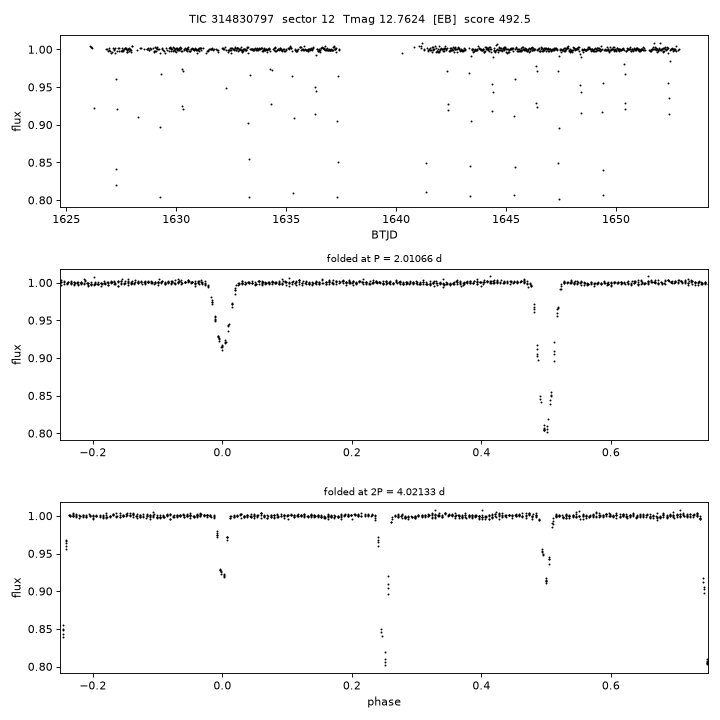
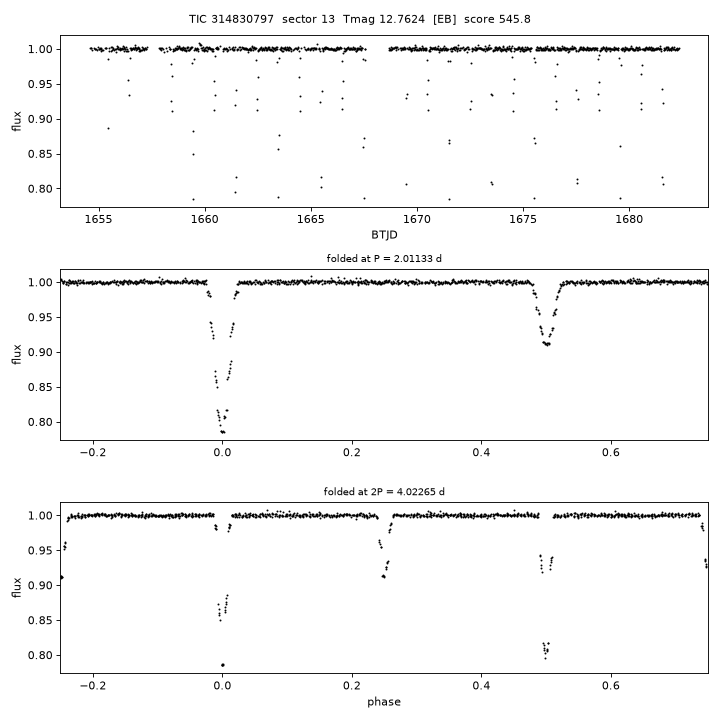
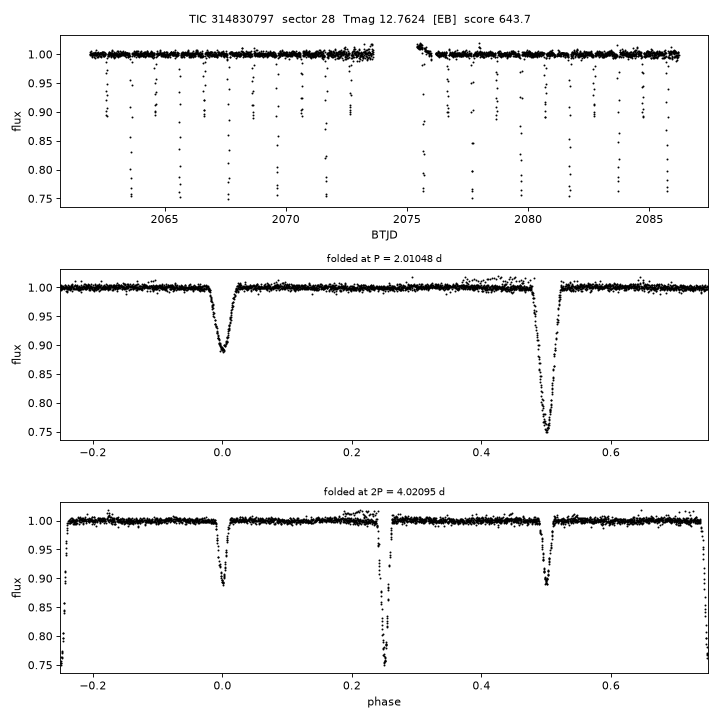
Notes
The signal
| Type | Pulsating star |
| Status | Rare, already known |
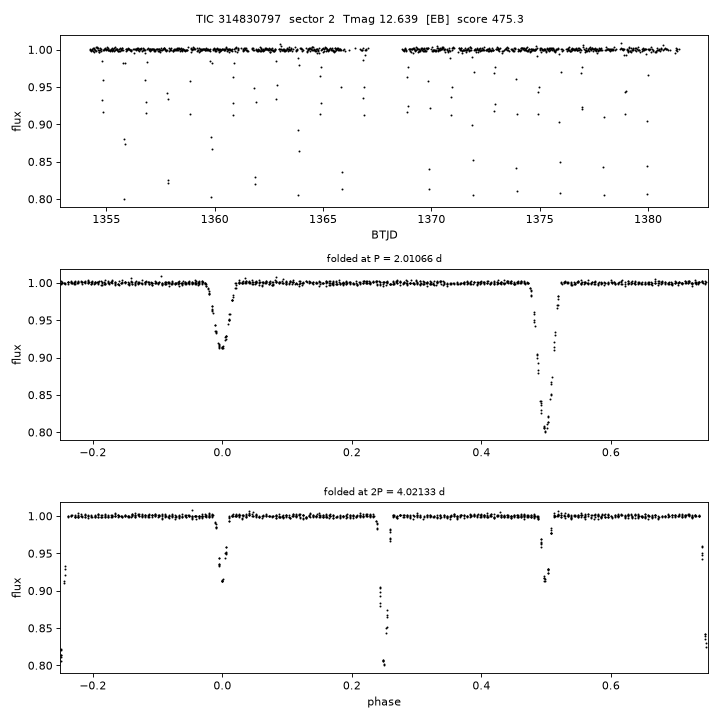
| Period (days) | 2.01048 |
| Period source | hunt.py on TESS QLP sector 28 |
| Eclipse / dip depth | 13.1% |
| Amplitude | 7.8% |
| Data used | TESS sector 28 (QLP) |
Deep check
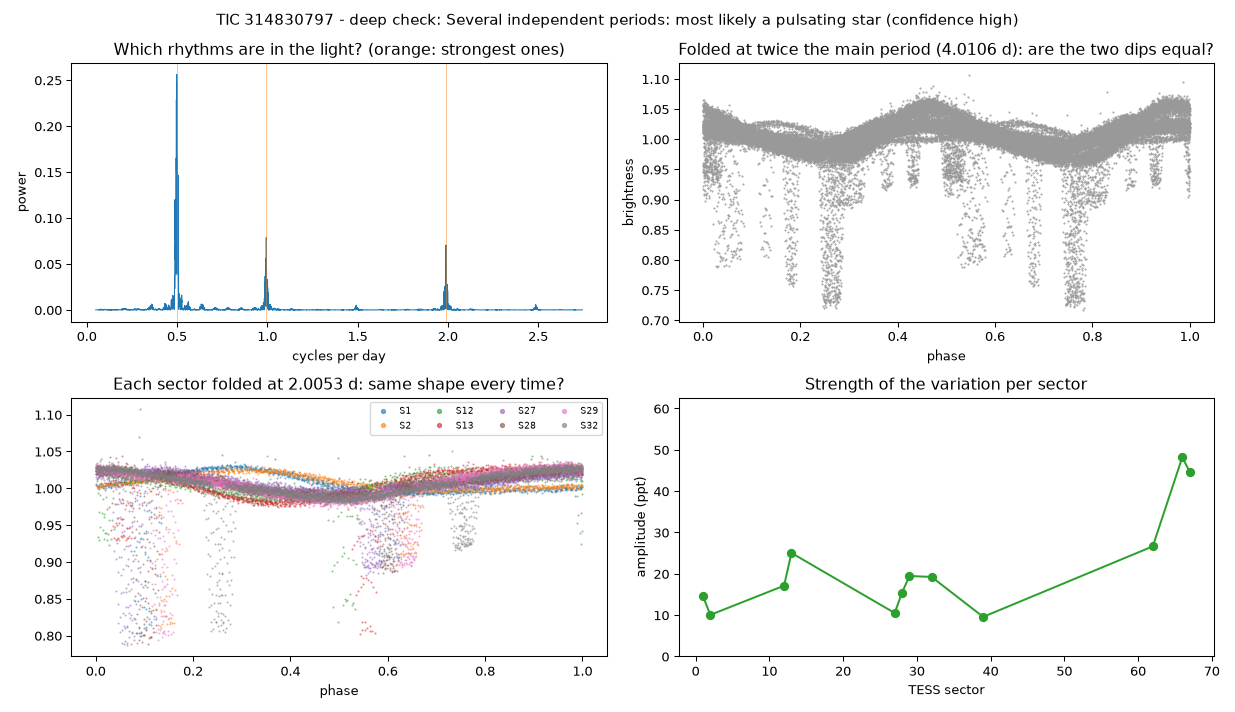
| What it most likely is | Several independent periods: most likely a pulsating star (confidence: high) |
| True period | 2.005282 d |
Why
| |
The star (Gaia & TESS)
| Distance (pc) | 185 (~603 light years) |
| Temperature (Gaia) | 3,915 K |
| Size (Gaia) | 0.84 x the Sun |
| Mass (Gaia) | 0.68 x the Sun |
| Luminosity (Gaia) | 0.15 x the Sun |
| Colour, Gaia BP-RP | 1.70 |
| RUWE (Gaia) | 1.07 - fits a single star |
| Gaia G mag | 13.57 |
| TESS mag | 12.76 |
Names & neighbours
| TIC ID | 314830797 |
| Gaia DR3 ID | 4627168520832585856 |
| SIMBAD name | UCAC4 063-002524 [PM*] |
| Nearest known variable | none within 5' |
| RA (deg) | 52.644 |
| Dec (deg) | -77.4751 |
| Look it up | SIMBAD · VSX · ESASky · ExoFOP |
Record
| Found by | hunt.py (automatic) |
| Date | 2026-10-02 |
| Last update | 2026-10-12 |
Where it sits among the stars
ESA Gaia colour and true brightness. Grey: every Star Log candidate. Orange: this star.
Data files
- 10_rare_check.png 32 KB
- 9_deep_check.png 174 KB
- TIC314830797_s0002.fits 79 KB
- TIC314830797_s0002.png 40 KB
- TIC314830797_s0012.fits 82 KB
- TIC314830797_s0012.png 39 KB
- TIC314830797_s0013.fits 82 KB
- TIC314830797_s0013.png 41 KB
- TIC314830797_s0028.fits 200 KB
- TIC314830797_s0028.png 53 KB
- deep_check.json 3 KB
- rare_check.json 10 KB
- thumb.png 49 KB
- meta.json