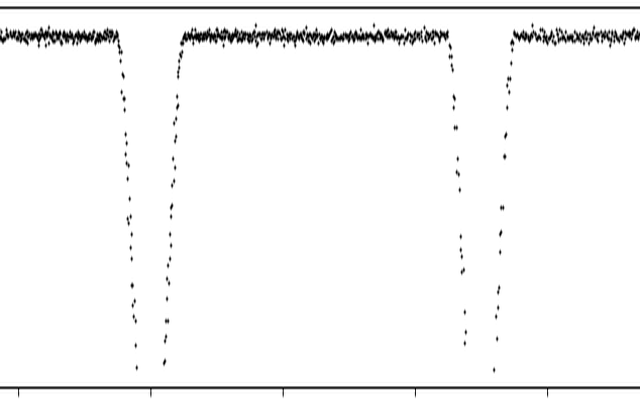
TIC 328141469
Eclipsing binaryRare, already known
Rare & notable finds
Something genuinely unusual turned up. Treat it as a lead: every one of these has ordinary explanations too, listed with each. How these checks work →
Already known: the catalogued variable ASAS J180448-3634.3 (ED, 39" away) has the same period - its light leaks into TESS's big pixels; same period as the known variable ASAS J180448-3634.3. The rare-find check confirms what is on record - still nice, but not a new discovery.
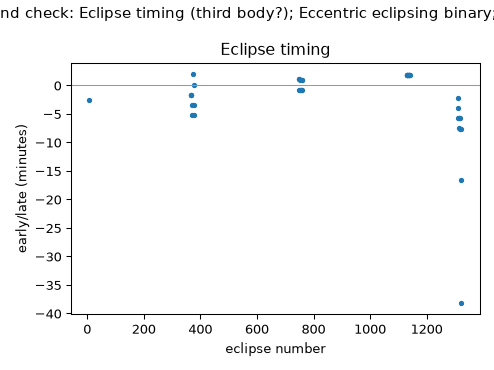
- Eclipse timing (third body?) significant
The eclipses drift early and late by 6.8 min, repeating every ~698 days: light taking longer or shorter to reach us as the pair is pulled around by a hidden third star (or planet), or a slowly turning eccentric orbit. - Eccentric eclipsing binary notable
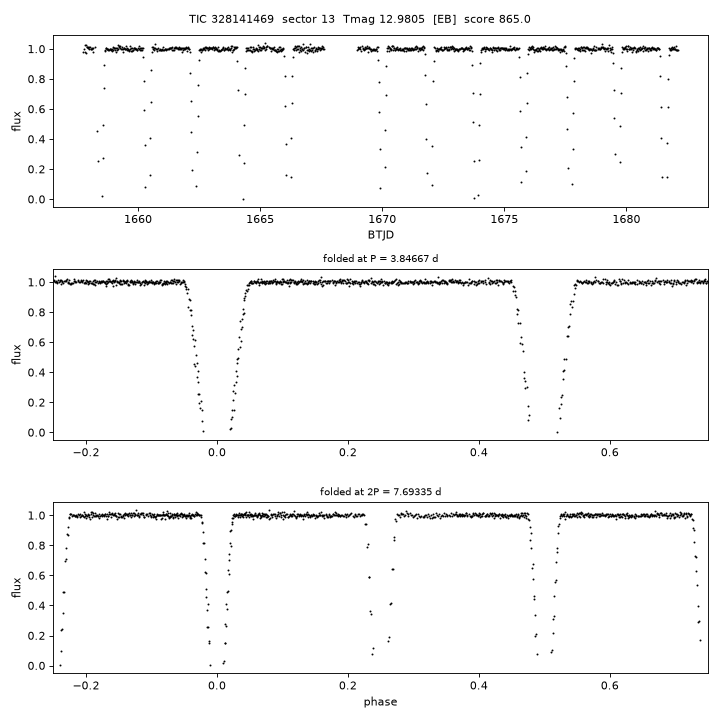
The second eclipse comes at phase 0.190 instead of 0.5: the orbit is stretched (eccentricity at least 0.487). Eccentric binaries show how tides shape orbits, and their slowly turning orbits test General Relativity. - Transits of a giant star notable
Gaia places this star among the giants: planets transiting giants are rare, and a big star makes even a large planet's dip tiny.
Checked, nothing found (5)
Microlensing (rogue planet?) · Exocomet-shaped dip · Eclipses changing depth · Pulsating star in an eclipsing binary · Extra dips outside the eclipses
Checked 2026-10-12 01:04 on NVIDIA GeForce RTX 4070, using every TESS sector of this star. All results (.json)
Notes
The signal
| Type | Eclipsing binary |
| Status | Rare, already known |
| Period (days) | 3.84667 |
| Period source | hunt.py on TESS QLP sector 13 |
| Eclipse / dip depth | 73.6% |
| Amplitude | 50.9% |
| Data used | TESS sector 13 (QLP) |
The star (Gaia & TESS)
| Distance (pc) | 3,544 (~11,560 light years) |
| Colour, Gaia BP-RP | 1.47 |
| RUWE (Gaia) | 0.88 - fits a single star |
| Gaia G mag | 13.72 |
| TESS mag | 12.98 |
Names & neighbours
| TIC ID | 328141469 |
| Gaia DR3 ID | 4038676603181277184 |
| SIMBAD name | not in SIMBAD |
| Nearest known variable | ASAS J180448-3634.3 (ED, P = 3.849 d), 39" away (same period!) |
| RA (deg) | 271.19 |
| Dec (deg) | -36.5772 |
| Look it up | SIMBAD · VSX · ESASky · ExoFOP |
Record
| Found by | hunt.py (automatic) |
| Date | 2026-10-09 |
| Last update | 2026-10-12 |
Where it sits among the stars
ESA Gaia colour and true brightness. Grey: every Star Log candidate. Orange: this star.
Data files
- 10_rare_check.png 19 KB
- TIC328141469_s0013.fits 82 KB
- TIC328141469_s0013.png 41 KB
- rare_check.json 5 KB
- thumb.png 38 KB
- meta.json