TIC 33525558
Pulsating starChecked in depth
Rare & notable finds
Nothing rare: all 9 checks came back clear. What was checked →
Checked, nothing found (7)
Microlensing (rogue planet?) · Exocomet-shaped dip · Eclipse timing (third body?) · Eclipses changing depth · Pulsating star in an eclipsing binary · Extra dips outside the eclipses · Type of star
Checked 2026-10-11 22:32 on NVIDIA GeForce RTX 4070, using every TESS sector of this star. All results (.json)
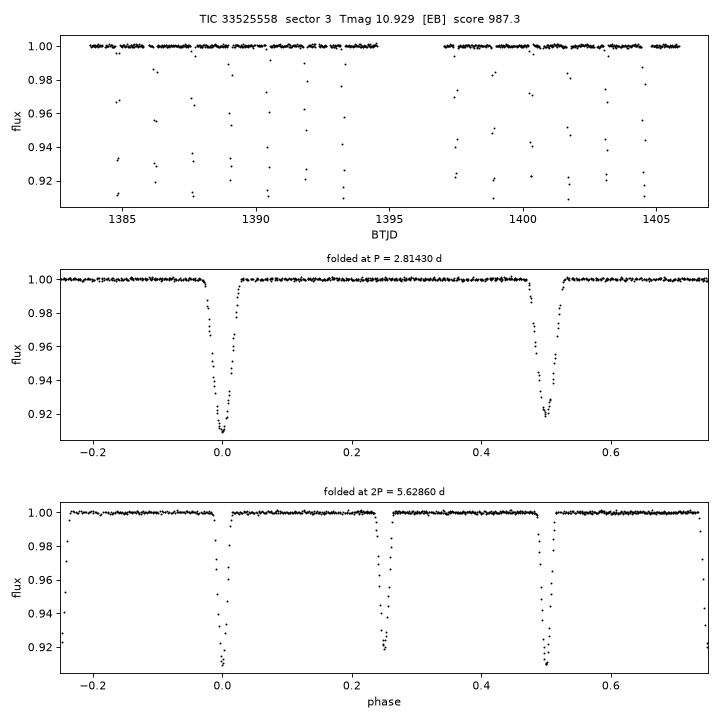
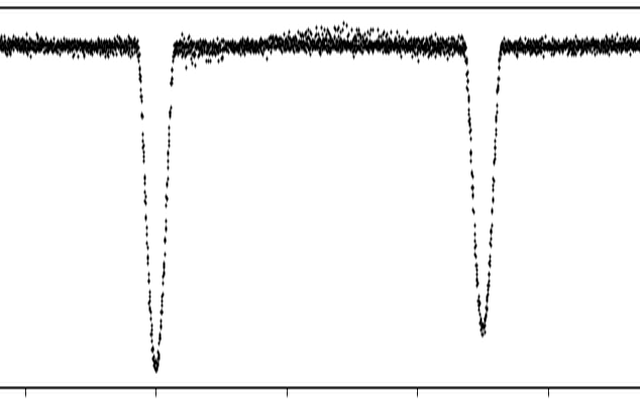
Notes
The signal
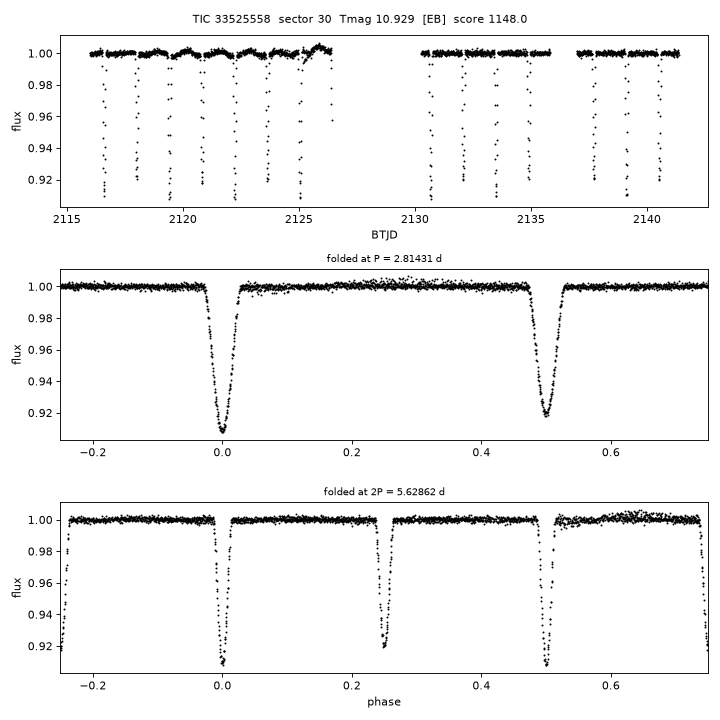
| Type | Pulsating star |
| Status | Checked in depth |
| Period (days) | 2.8145624 |
| Period source | eclipse fit to TESS sectors [3, 30, 97, 104] |
| Eclipse / dip depth | 6.6% |
| Amplitude | 5.7% |
| Data used | TESS sector 30 (QLP) |
Deep check
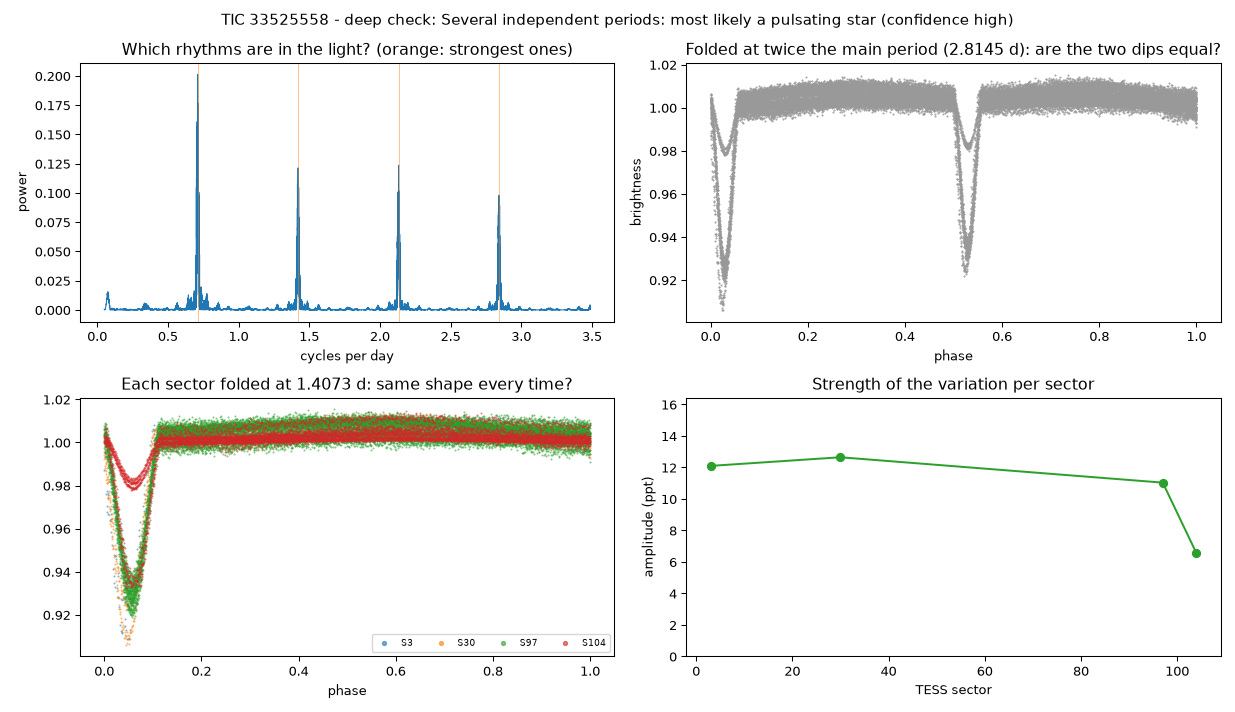
| What it most likely is | Several independent periods: most likely a pulsating star (confidence: high) |
| True period | 1.407271 d |
Why
| |
The star (Gaia & TESS)
| Distance (pc) | 489 (~1,597 light years) |
| Temperature (Gaia) | 6,102 K |
| Size (Gaia) | 2.03 x the Sun |
| Mass (Gaia) | 1.38 x the Sun |
| Luminosity (Gaia) | 5.16 x the Sun |
| Colour, Gaia BP-RP | 0.68 |
| RUWE (Gaia) | 1.54 - hints at a hidden companion star |
| Gaia G mag | 11.29 |
| TESS mag | 10.93 |
Names & neighbours
| TIC ID | 33525558 |
| Gaia DR3 ID | 5024148980747441664 |
| SIMBAD name | TYC 6431-162-1 [*] |
| Nearest known variable | Gaia DR3 5024149839740446976 (ROT), 91" away |
| RA (deg) | 27.0265 |
| Dec (deg) | -28.4484 |
| Look it up | SIMBAD · VSX · ESASky · ExoFOP |
Record
| Found by | hunt.py (automatic) |
| Date | 2026-10-02 |
| Last update | 2026-10-04 |
✦ Artist's impression
What this picture shows
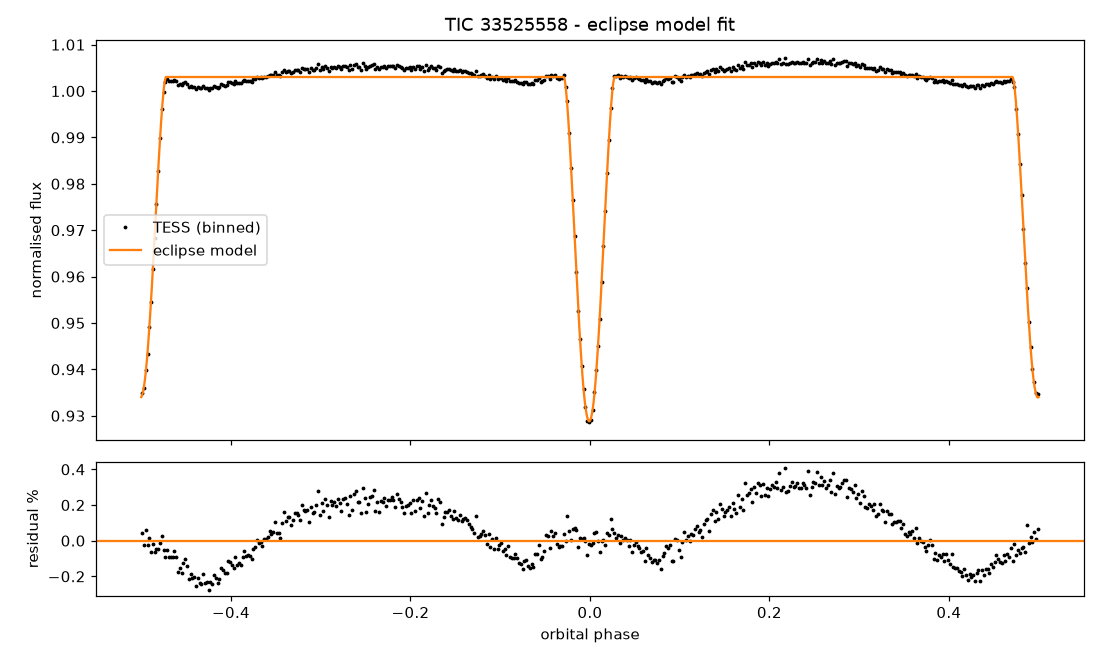
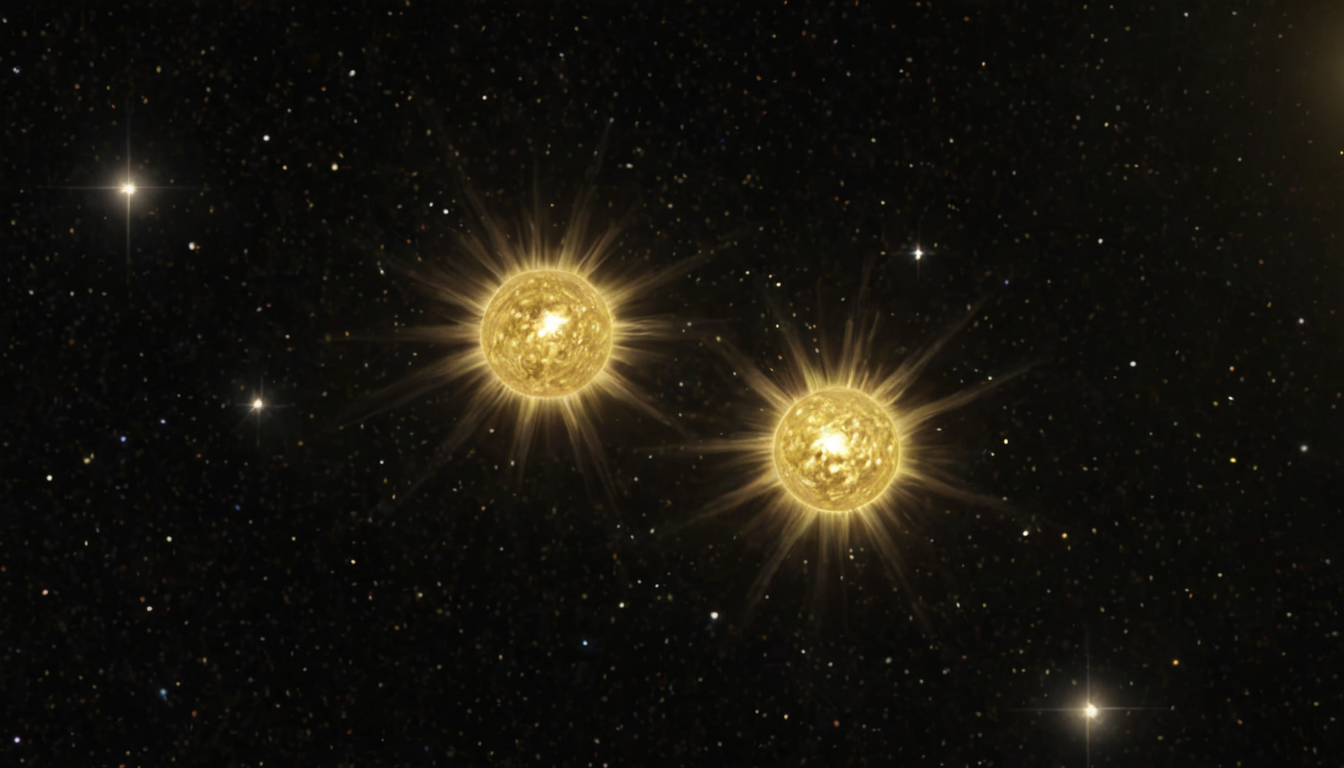
Artist's impression of an UNCONFIRMED candidate, based on its measured data. Two stars of about 6,100 K and 6,000 K (1.4 and 1.4 times the Sun's radius, ~1.1 and ~1.1 solar masses) orbit each other every 67.5 hours, 7.6 million km apart (the Sun-Mercury distance is 58 million km). We see the orbit at 79 degrees (90 = exactly edge-on), close enough to edge-on that they eclipse each other. Sizes, separation, tilt and colours come from fitting the TESS eclipses (see the model-fit plot) plus Gaia's temperature; masses assume normal main-sequence stars. The painted look, surface detail and background were added by a locally run image AI; the stars' sizes, colours and spacing follow the measured data.
How it was made
Painted by an image AI (DreamShaper XL, a Stable Diffusion XL model) running locally on a home PC, over a 3D layout built from the measured data. No cloud services.
Where it sits among the stars
ESA Gaia colour and true brightness. Grey: every Star Log candidate. Orange: this star.
Data files
- 0_illustration.png 1 MB
- 4_eclipse_model.png 55 KB
- 9_deep_check.png 148 KB
- TIC33525558_s0003.fits 82 KB
- TIC33525558_s0003.png 38 KB
- TIC33525558_s0030.fits 217 KB
- TIC33525558_s0030.png 51 KB
- deep_check.json 2 KB
- model.json 793 B
- rare_check.json 5 KB
- thumb.png 51 KB
- meta.json