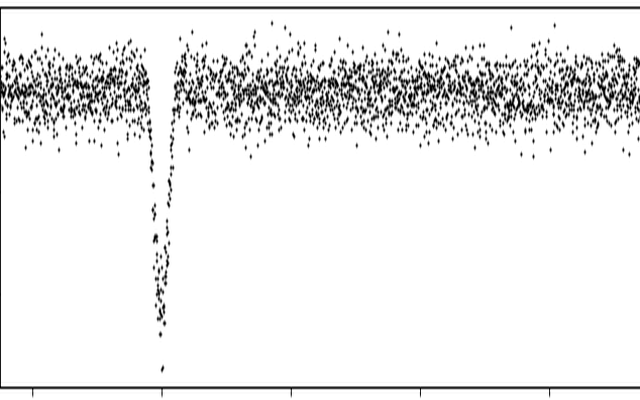
TIC 404804908
Transit candidateRare, already known
Rare & notable finds
Something genuinely unusual turned up. Treat it as a lead: every one of these has ordinary explanations too, listed with each. How these checks work →
Already known: on NASA's TESS list as CTOI 404804908.01 (PC); in the TESS eclipsing-binary catalogue (Prsa et al. 2022) as TIC 0404804908; in SIMBAD as HD 269912B (*), 4.2" away; catalogued variable star nearby: Gaia DR3 4657109047154023808 (BE|GCAS|SDOR|WR), 51" away. The rare-find check confirms what is on record - still nice, but not a new discovery.
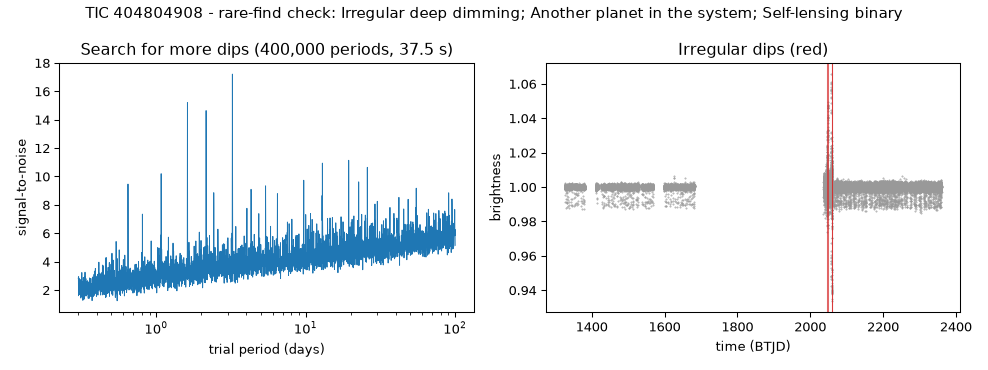
- Irregular deep dimming significant
4 deep dips at irregular times, depths from 0.8% to 7.5%. Not periodic and not a young star - like Boyajian's star ('Tabby's star'), one of the strangest stars known. - Another planet in the system significant
Another set of dips every 3.2246 days (359 ppm, 43 seen, SNR 18.9). Its period is close to a 5:2 ratio with the known one (orbital resonance). - Self-lensing binary significant
Short brightenings repeat every 3.2246 days (590 ppm, 63 seen): a white dwarf (or other compact star) magnifying its companion each time it passes in front - only a handful known.
Checked, nothing found (10)
Microlensing (rogue planet?) · Exocomet-shaped dip · Habitable zone & size · Transit timing (TTV) · Transit duration (TDV) · Changing transit depth · Lopsided transit · Dimming beside the transit · Trojan companions (L4/L5) · Type of star
Checked 2026-10-11 18:06 on NVIDIA GeForce RTX 4070, using every TESS sector of this star. All results (.json)
Notes
The signal
| Type | Transit candidate |
| Status | Rare, already known |
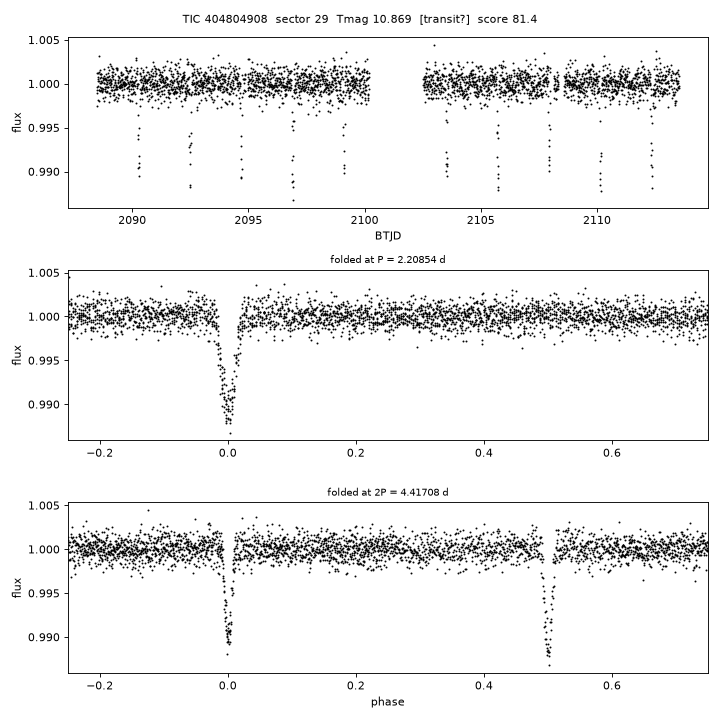
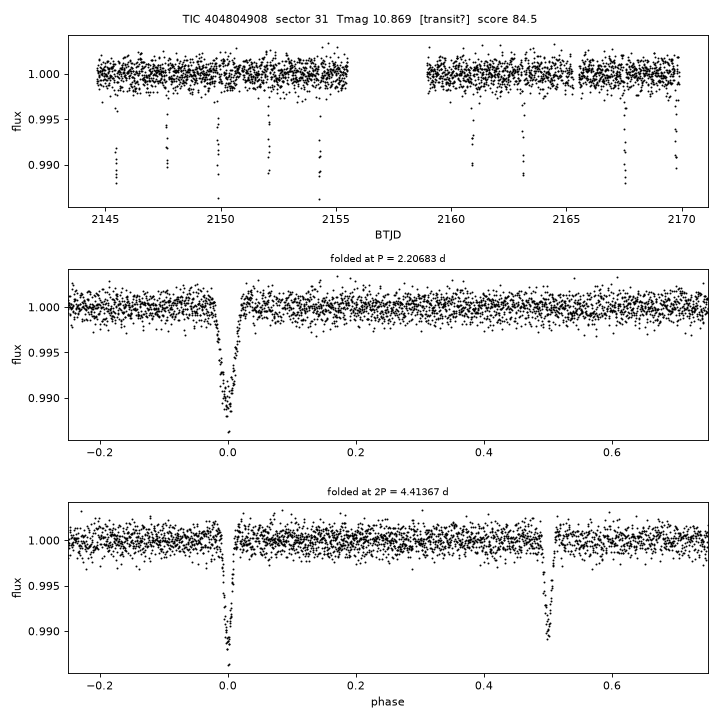
| Period (days) | 2.20683 |
| Period source | hunt.py on TESS QLP sector 31 |
| Eclipse / dip depth | 0.8% |
| Amplitude | 0.4% |
| Data used | TESS sector 31 (QLP) |
Planet check
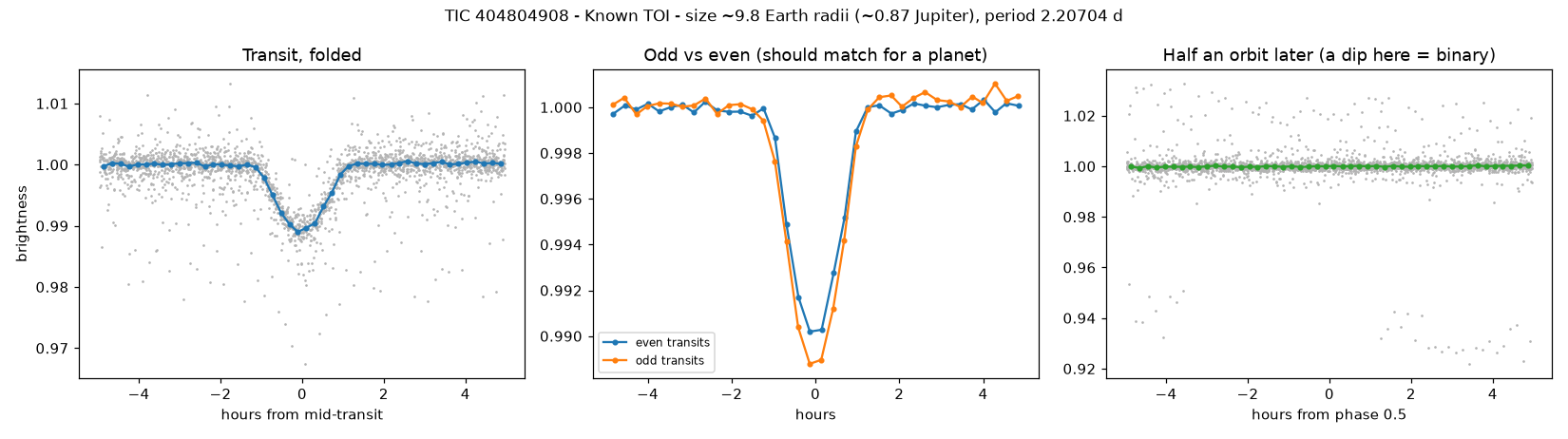
| Verdict | Already known to NASA: CTOI 404804908.01 (PC) |
| Size if it's a planet | ~9.8 Earth radii (~0.87 Jupiter) |
The star (Gaia & TESS)
| Distance (pc) | 457 (~1,489 light years) |
| Colour, Gaia BP-RP | 0.78 |
| RUWE (Gaia) | 3.85 - hints at a hidden companion star |
| Gaia G mag | 12.07 |
| TESS mag | 10.87 |
Names & neighbours
| TIC ID | 404804908 |
| Gaia DR3 ID | 4657085579412104832 |
| SIMBAD name | HD 269912B [*] |
| Nearest known variable | Gaia DR3 4657109047154023808 (BE|GCAS|SDOR|WR), 51" away |
| RA (deg) | 84.7634 |
| Dec (deg) | -70.9028 |
| Look it up | SIMBAD · VSX · ESASky · ExoFOP |
Record
| Found by | hunt.py (automatic) |
| Date | 2026-10-12 |
| Last update | 2026-10-12 |
Where it sits among the stars
ESA Gaia colour and true brightness. Grey: every Star Log candidate. Orange: this star.
Data files
- 10_rare_check.png 55 KB
- 5_planet_check.png 97 KB
- TIC404804908_s0029.fits 208 KB
- TIC404804908_s0029.png 65 KB
- TIC404804908_s0031.fits 200 KB
- TIC404804908_s0031.png 63 KB
- lightcurve_all_sectors.csv 638 KB
- planet_check.json 4 KB
- rare_check.json 7 KB
- thumb.png 110 KB
- meta.json