TIC 406279367
Eclipsing binaryChecked in depth
Notes
The signal
| Type | Eclipsing binary |
| Status | Checked in depth |
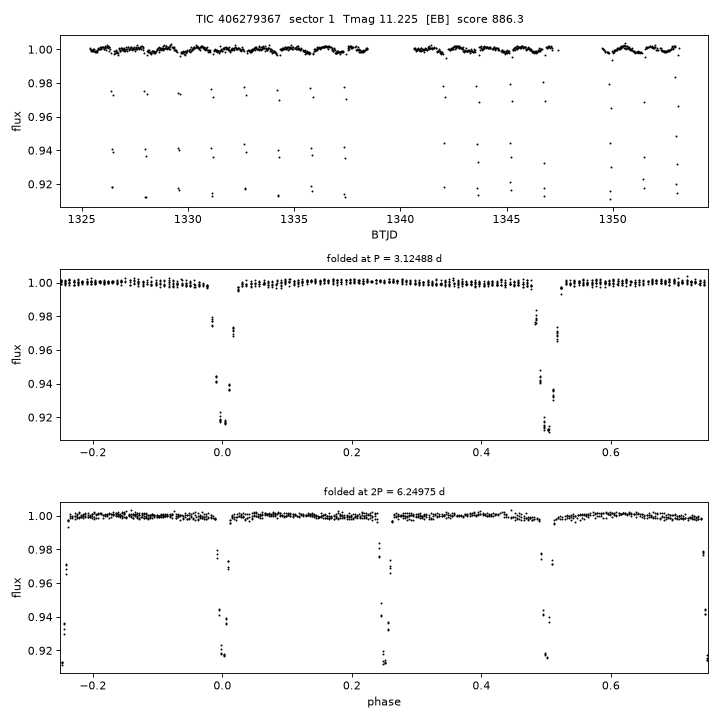
| Period (days) | 3.1254636 |
| Period source | eclipse fit to TESS sectors [1, 27, 67, 94, 95, 101, 102, 104] |
| Eclipse / dip depth | 7.2% |
| Amplitude | 5.8% |
| Data used | TESS sector 1 (QLP) |
Deep check
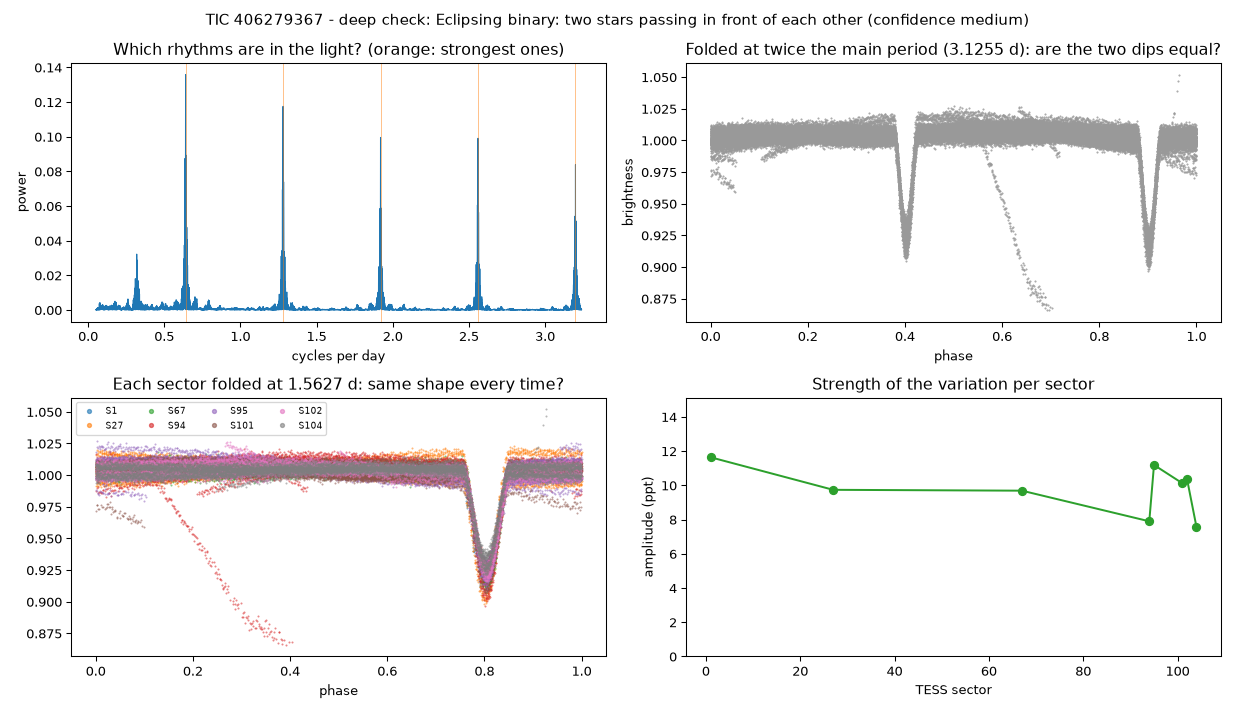
| What it most likely is | Eclipsing binary: two stars passing in front of each other (confidence: medium) |
| True period | 3.125459 d (twice the hunt's period: two dips per orbit) |
Why
| |
The star (Gaia & TESS)
| Distance (pc) | 456 (~1,489 light years) |
| Temperature (Gaia) | 5,647 K |
| Size (Gaia) | 1.86 x the Sun |
| Mass (Gaia) | 1.11 x the Sun |
| Luminosity (Gaia) | 3.17 x the Sun |
| Colour, Gaia BP-RP | 0.82 |
| RUWE (Gaia) | 1.48 - hints at a hidden companion star |
| Radial velocity (Gaia) | speed changes by 175 km/s - likely an orbiting pair |
| Gaia G mag | 11.70 |
| TESS mag | 11.22 |
Names & neighbours
| TIC ID | 406279367 |
| Gaia DR3 ID | 6402333617289981056 |
| SIMBAD name | TYC 9119-1863-1 [*] |
| Nearest known variable | none within 5' |
| RA (deg) | 326.376 |
| Dec (deg) | -64.3269 |
| Look it up | SIMBAD · VSX · ESASky · ExoFOP |
Record
| Found by | hunt.py (automatic) |
| Date | 2026-10-01 |
| Last update | 2026-10-04 |
✦ Artist's impression
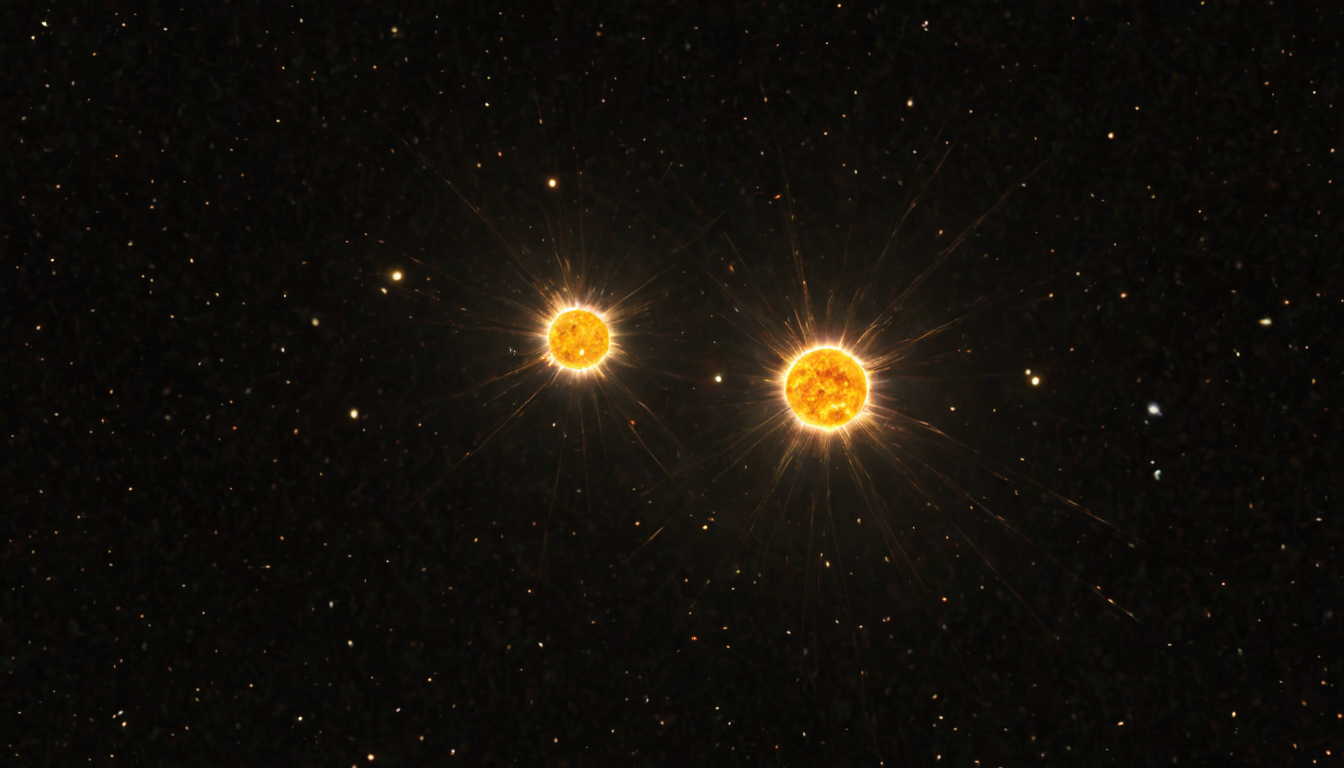
What this picture shows
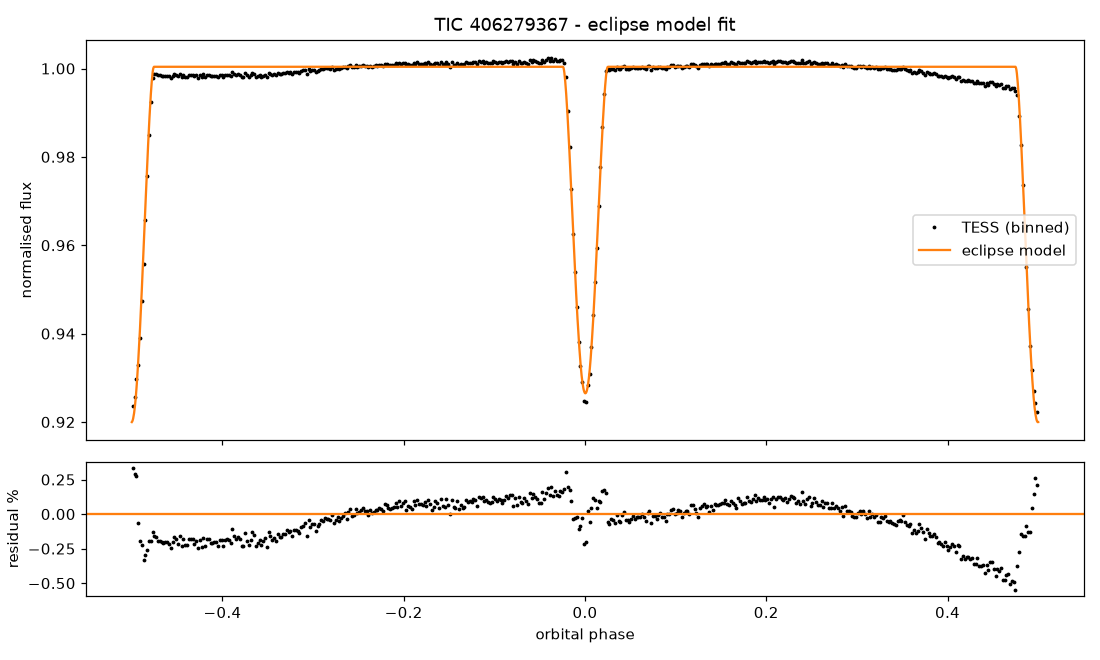
Artist's impression of an UNCONFIRMED candidate, based on its measured data. Two stars of about 5,600 K and 5,800 K (1.2 and 1.3 times the Sun's radius, ~1.0 and ~1.0 solar masses) orbit each other every 75.0 hours, 7.9 million km apart (the Sun-Mercury distance is 58 million km). We see the orbit at 81 degrees (90 = exactly edge-on), close enough to edge-on that they eclipse each other. Sizes, separation, tilt and colours come from fitting the TESS eclipses (see the model-fit plot) plus Gaia's temperature; masses assume normal main-sequence stars. The painted look, surface detail and background were added by a locally run image AI; the stars' sizes, colours and spacing follow the measured data.
How it was made
Painted by an image AI (DreamShaper XL, a Stable Diffusion XL model) running locally on a home PC, over a 3D layout built from the measured data. No cloud services.
Where it sits among the stars
ESA Gaia colour and true brightness. Grey: every Star Log candidate. Orange: this star.
Data files
- 0_illustration.png 1017 KB
- 4_eclipse_model.png 50 KB
- 9_deep_check.png 153 KB
- TIC406279367_s0001.fits 79 KB
- TIC406279367_s0001.png 42 KB
- deep_check.json 3 KB
- model.json 797 B
- thumb.png 33 KB
- meta.json