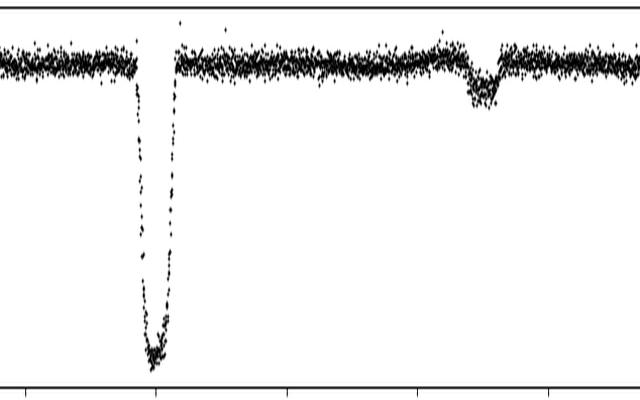
TIC 407992462
Pulsating starNotable, already known
Rare & notable finds
A notable find: not unheard of, but the kind of system astronomers are glad to have more of. How these checks work →
Already known: in SIMBAD as GSC 00659-00797 (SB*); catalogued variable star nearby: Gaia DR3 3298706308360375552 (ROT), 211" away; in the ATLAS variable-star catalogue (Heinze et al. 2018) as J060.8735+08.6206. The rare-find check confirms what is on record - still nice, but not a new discovery.
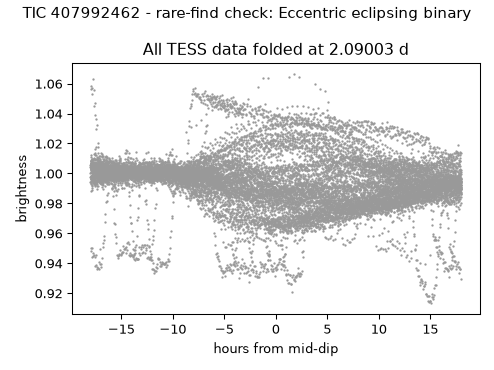
- Eccentric eclipsing binary notable
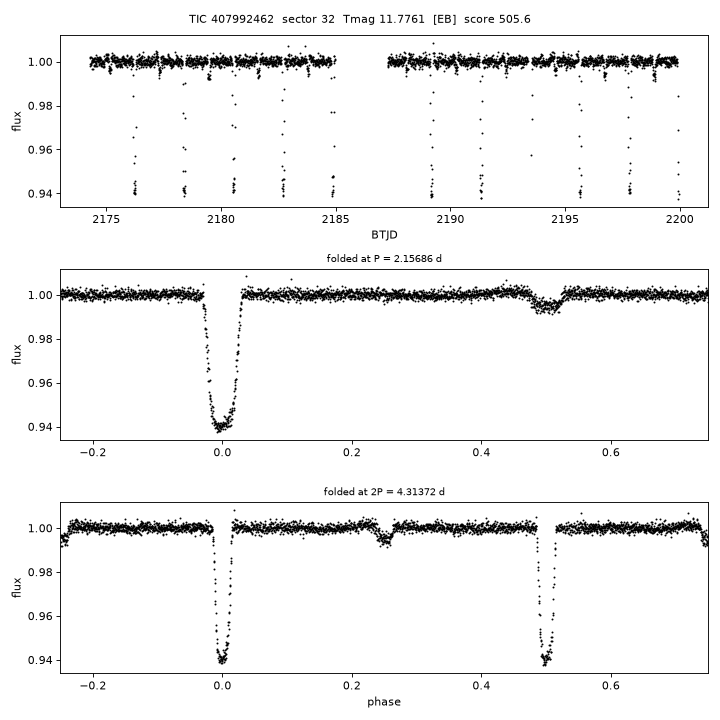
The second eclipse comes at phase 0.329 instead of 0.5: the orbit is stretched (eccentricity at least 0.268). Eccentric binaries show how tides shape orbits, and their slowly turning orbits test General Relativity.
Checked, nothing found (8)
Microlensing (rogue planet?) · Exocomet-shaped dip · Eclipse timing (third body?) · Eclipses changing depth · Pulsating star in an eclipsing binary · Extra dips outside the eclipses · Heartbeat star · Type of star
Checked 2026-10-12 15:29 on NVIDIA GeForce RTX 4070, using every TESS sector of this star. All results (.json)
Notes
The signal
| Type | Pulsating star |
| Status | Notable, already known |
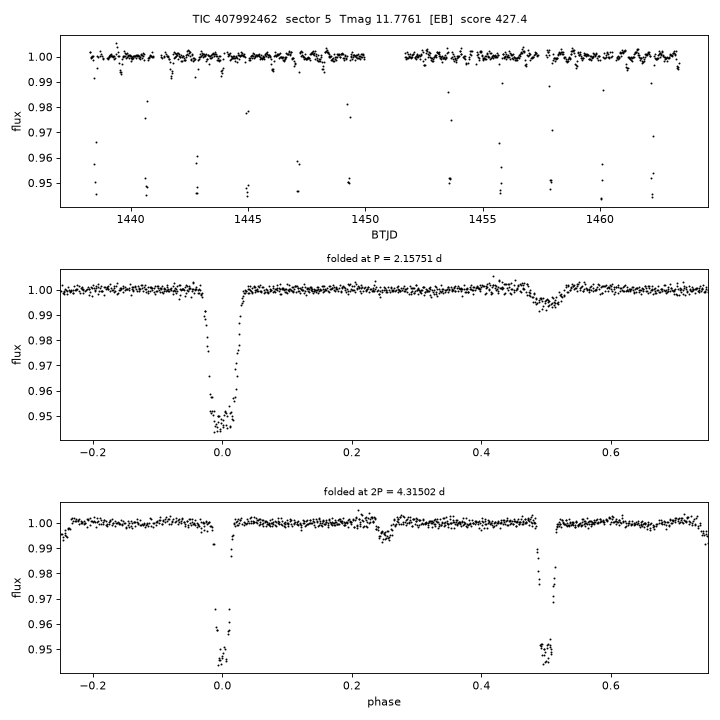
| Period (days) | 2.15686 |
| Period source | hunt.py on TESS QLP sector 32 |
| Eclipse / dip depth | 5.3% |
| Amplitude | 1.1% |
| Data used | TESS sector 32 (QLP) |
Deep check
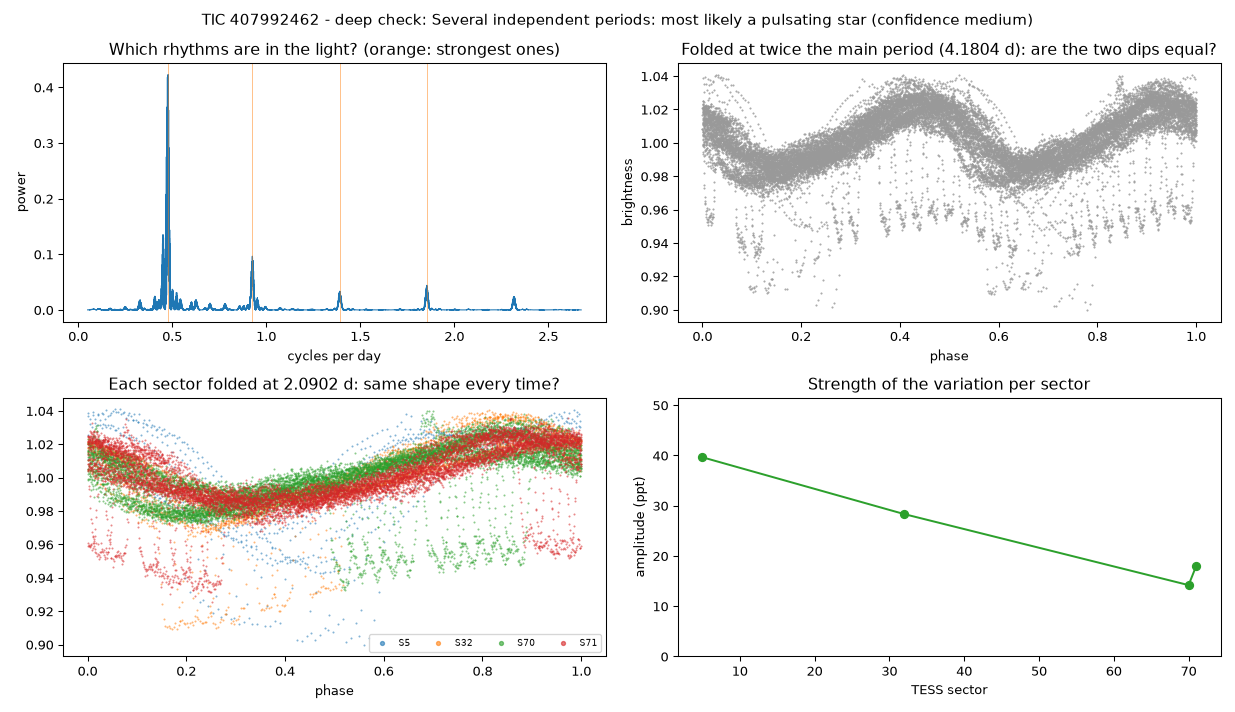
| What it most likely is | Several independent periods: most likely a pulsating star (confidence: medium) |
| True period | 2.090177 d |
Why
| |
The star (Gaia & TESS)
| Distance (pc) | 313 (~1,022 light years) |
| Temperature (Gaia) | 5,167 K |
| Size (Gaia) | 1.34 x the Sun |
| Mass (Gaia) | 0.90 x the Sun |
| Luminosity (Gaia) | 1.12 x the Sun |
| Colour, Gaia BP-RP | 1.11 |
| RUWE (Gaia) | 1.11 - fits a single star |
| Radial velocity (Gaia) | speed changes by 123 km/s - likely an orbiting pair |
| Gaia G mag | 12.35 |
| TESS mag | 11.78 |
Names & neighbours
| TIC ID | 407992462 |
| Gaia DR3 ID | 3298709572535521664 |
| SIMBAD name | GSC 00659-00797 [SB*] |
| Nearest known variable | Gaia DR3 3298706308360375552 (ROT), 211" away |
| RA (deg) | 60.8736 |
| Dec (deg) | 8.6206 |
| Look it up | SIMBAD · VSX · ESASky · ExoFOP |
Record
| Found by | hunt.py (automatic) |
| Date | 2026-10-02 |
| Last update | 2026-10-12 |
Where it sits among the stars
ESA Gaia colour and true brightness. Grey: every Star Log candidate. Orange: this star.
Data files
- 10_rare_check.png 52 KB
- 9_deep_check.png 218 KB
- TIC407992462_s0005.fits 76 KB
- TIC407992462_s0005.png 45 KB
- TIC407992462_s0032.fits 205 KB
- TIC407992462_s0032.png 55 KB
- deep_check.json 2 KB
- rare_check.json 4 KB
- thumb.png 57 KB
- meta.json