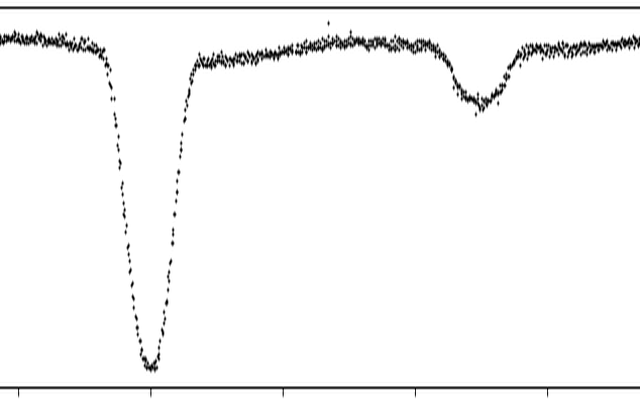
TIC 68076357
Eclipsing binaryProbably known
Rare & notable finds
Nothing rare: all 9 checks came back clear. What was checked →
Checked, nothing found (7)
Microlensing (rogue planet?) · Exocomet-shaped dip · Eclipse timing (third body?) · Eccentric eclipsing binary · Pulsating star in an eclipsing binary · Extra dips outside the eclipses · Type of star
Checked 2026-10-12 01:19 on NVIDIA GeForce RTX 4070, using every TESS sector of this star. All results (.json)
Notes
WARNING: same period as the known variable TSVSC1 TN-N133111222-30-67-1 35" away; the signal is probably its light leaking in.
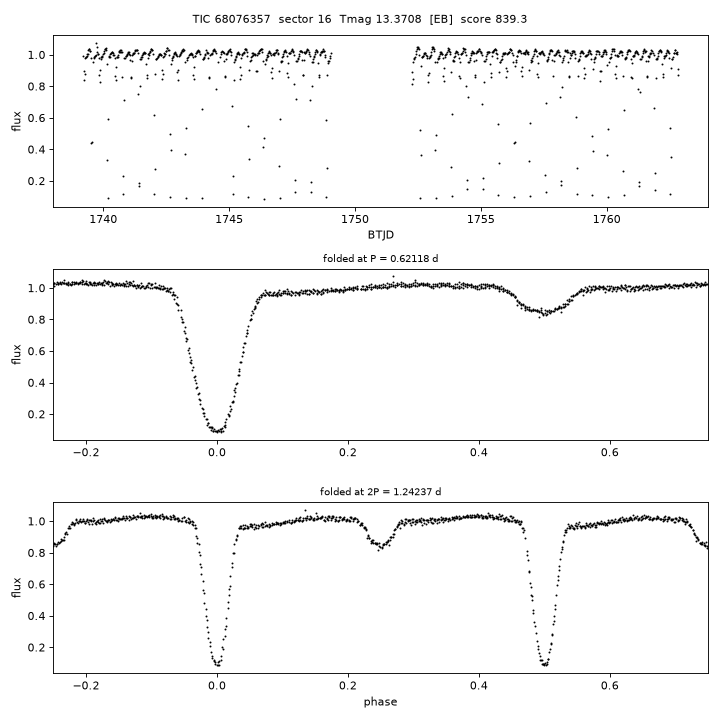
Found automatically by hunt.py in TESS sector 16 (flagged in 2 sector(s)). Detection score 839.3.
Not in VSX, ASAS-SN or ZTF variable catalogues at the time of the search; not in Gaia DR3's variable lists.
Unchecked by hand yet: verify the period, nearby stars and a wider catalogue search.
Updates:
2026-10-10 Gaia hints at a hidden companion star (RUWE 1.7)
2026-10-10 Found by the automatic search in TESS sector 16
The signal
| Type | Eclipsing binary |
| Status | Probably known |
| Period (days) | 0.621184 |
| Period source | hunt.py on TESS QLP sector 16 |
| Eclipse / dip depth | 65.3% |
| Amplitude | 72.2% |
| Data used | TESS sector 16 (QLP) |
The star (Gaia & TESS)
| Distance (pc) | 704 (~2,295 light years) |
| Temperature (Gaia) | 5,582 K |
| Size (Gaia) | 1.12 x the Sun |
| Mass (Gaia) | 0.90 x the Sun |
| Luminosity (Gaia) | 1.10 x the Sun |
| Colour, Gaia BP-RP | 0.82 |
| RUWE (Gaia) | 1.74 - hints at a hidden companion star |
| Gaia G mag | 13.79 |
| TESS mag | 13.37 |
Names & neighbours
| TIC ID | 68076357 |
| Gaia DR3 ID | 1489682266721019904 |
| SIMBAD name | not in SIMBAD |
| Nearest known variable | TSVSC1 TN-N133111222-30-67-1 (VAR, P = 0.62101 d), 35" away (same period!) |
| RA (deg) | 221.063 |
| Dec (deg) | 41.3453 |
| Look it up | SIMBAD · VSX · ESASky · ExoFOP |
Record
| Found by | hunt.py (automatic) |
| Date | 2026-10-10 |
| Last update | 2026-10-10 |
Where it sits among the stars
ESA Gaia colour and true brightness. Grey: every Star Log candidate. Orange: this star.
Data files
- TIC68076357_s0016.fits 70 KB
- TIC68076357_s0016.png 42 KB
- rare_check.json 4 KB
- thumb.png 39 KB
- meta.json