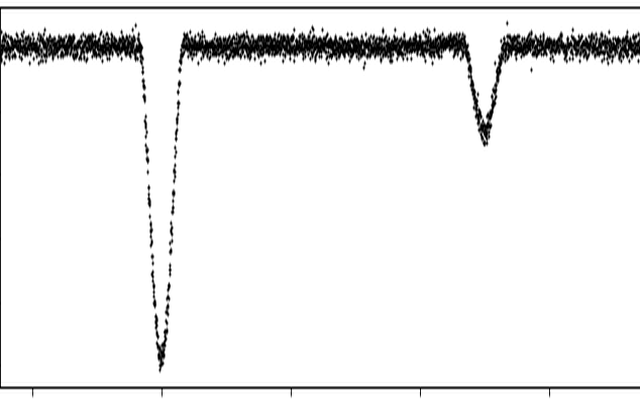
TIC 77178454
Pulsating starNotable, already known
Rare & notable finds
A notable find: not unheard of, but the kind of system astronomers are glad to have more of. How these checks work →
Already known: in SIMBAD as UCAC4 270-004963 (*); catalogued variable star nearby: Gaia DR3 4867376661489281280 (ROT), 189" away. The rare-find check confirms what is on record - still nice, but not a new discovery.
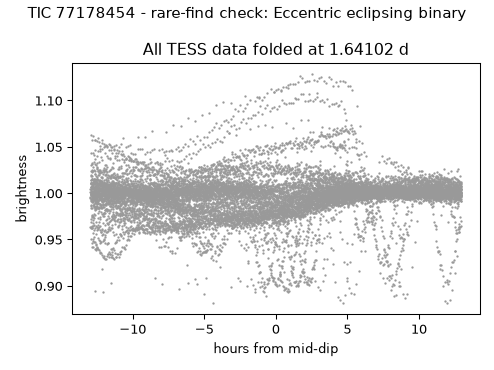
- Eccentric eclipsing binary notable
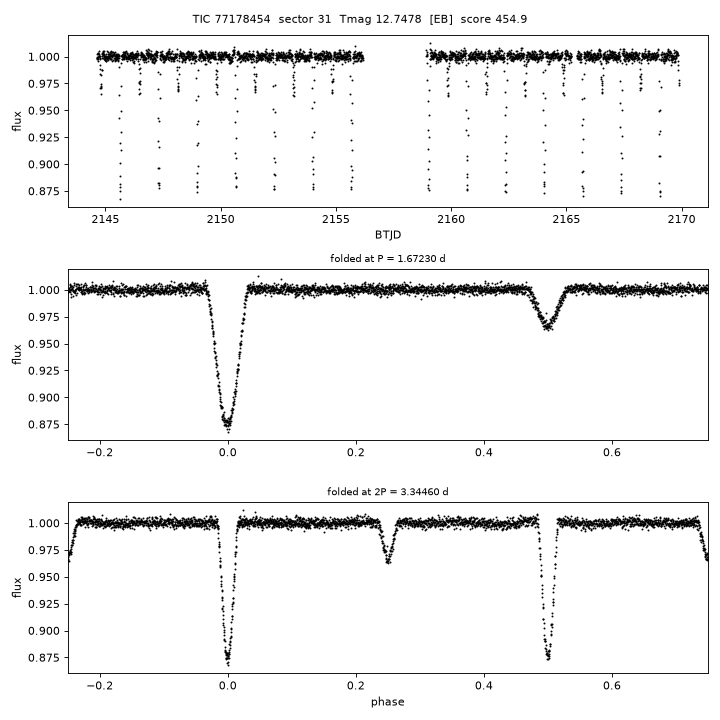
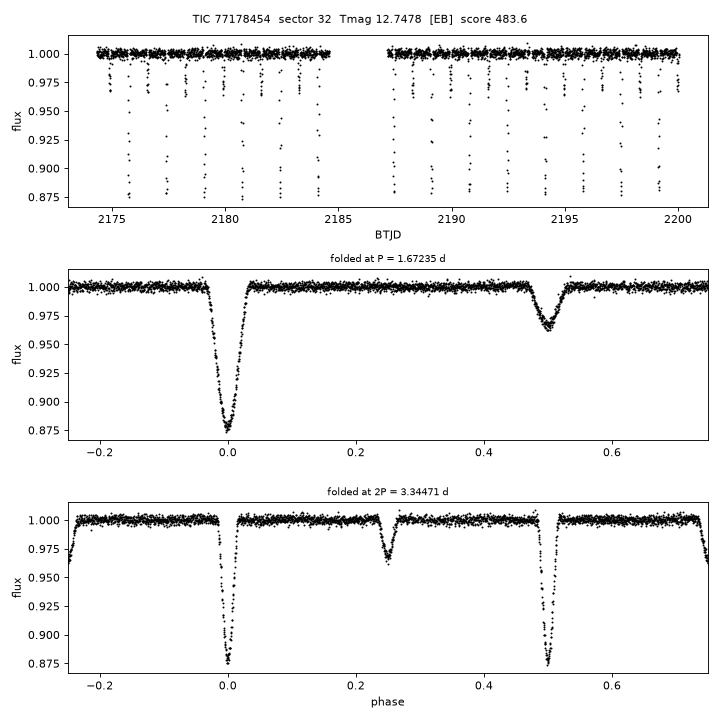
The second eclipse comes at phase 0.828 instead of 0.5: the orbit is stretched (eccentricity at least 0.515). Eccentric binaries show how tides shape orbits, and their slowly turning orbits test General Relativity.
Checked, nothing found (9)
Microlensing (rogue planet?) · Exocomet-shaped dip · Eclipse timing (third body?) · Eclipses changing depth · Pulsating star in an eclipsing binary · Second eclipsing pair · Extra dips outside the eclipses · Heartbeat star · Type of star
Checked 2026-10-12 16:54 on NVIDIA GeForce RTX 4070, using every TESS sector of this star. All results (.json)
Notes
The signal
| Type | Pulsating star |
| Status | Notable, already known |
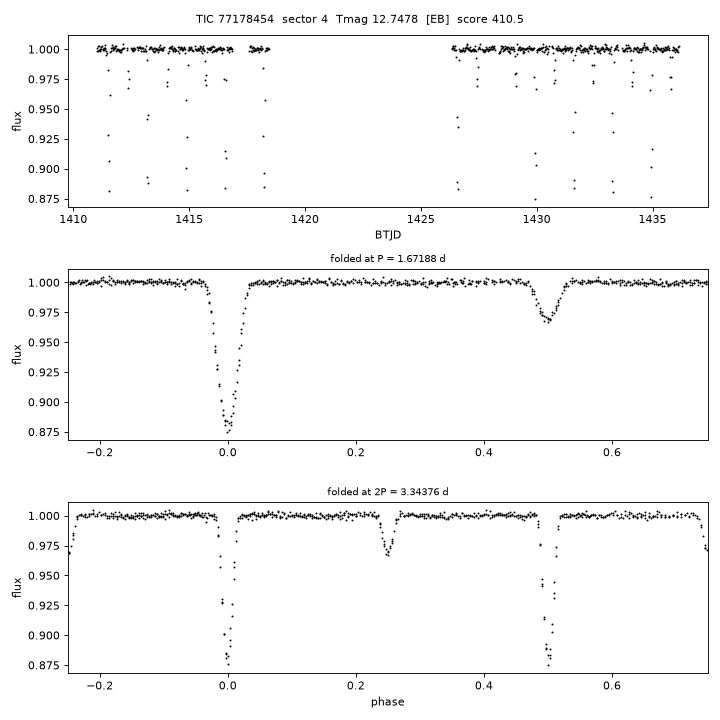
| Period (days) | 1.67235 |
| Period source | hunt.py on TESS QLP sector 32 |
| Eclipse / dip depth | 9.9% |
| Amplitude | 3.9% |
| Data used | TESS sector 32 (QLP) |
Deep check
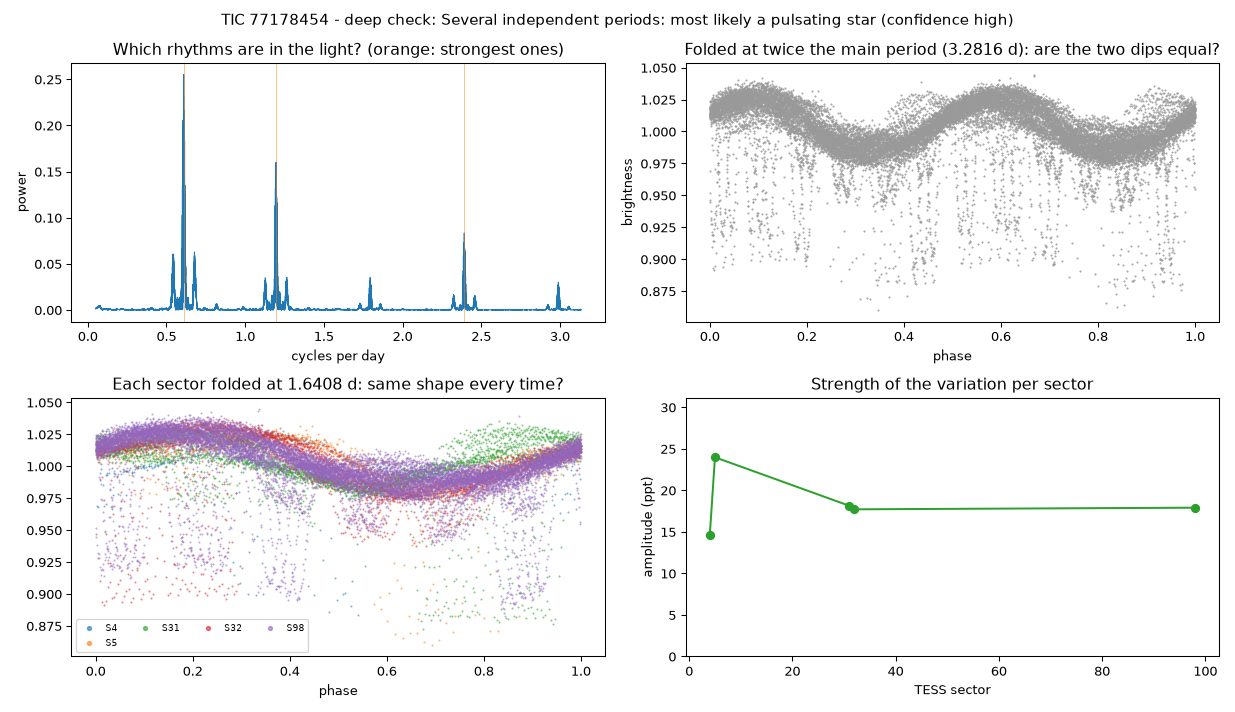
| What it most likely is | Several independent periods: most likely a pulsating star (confidence: high) |
| True period | 1.640805 d |
Why
| |
The star (Gaia & TESS)
| Distance (pc) | 586 (~1,910 light years) |
| Temperature (Gaia) | 5,459 K |
| Size (Gaia) | 1.31 x the Sun |
| Mass (Gaia) | 0.97 x the Sun |
| Luminosity (Gaia) | 1.33 x the Sun |
| Colour, Gaia BP-RP | 0.91 |
| RUWE (Gaia) | 4.94 - hints at a hidden companion star |
| Gaia G mag | 13.22 |
| TESS mag | 12.75 |
Names & neighbours
| TIC ID | 77178454 |
| Gaia DR3 ID | 4867388721757449344 |
| SIMBAD name | UCAC4 270-004963 [*] |
| Nearest known variable | Gaia DR3 4867376661489281280 (ROT), 189" away |
| RA (deg) | 68.7126 |
| Dec (deg) | -36.1995 |
| Look it up | SIMBAD · VSX · ESASky · ExoFOP |
Record
| Found by | hunt.py (automatic) |
| Date | 2026-10-02 |
| Last update | 2026-10-12 |
Where it sits among the stars
ESA Gaia colour and true brightness. Grey: every Star Log candidate. Orange: this star.
Data files
- 10_rare_check.png 45 KB
- 9_deep_check.png 211 KB
- TIC77178454_s0004.fits 68 KB
- TIC77178454_s0004.png 42 KB
- TIC77178454_s0031.fits 200 KB
- TIC77178454_s0031.png 60 KB
- TIC77178454_s0032.fits 205 KB
- TIC77178454_s0032.png 60 KB
- deep_check.json 2 KB
- rare_check.json 4 KB
- thumb.png 54 KB
- meta.json