TIC 91639902
Transit candidateRare, already known
Rare & notable finds
Something genuinely unusual turned up. Treat it as a lead: every one of these has ordinary explanations too, listed with each. How these checks work →
Already known: the catalogued variable Gaia DR3 4951754317676601344 (E, 34" away) has the same period - its light leaks into TESS's big pixels; same period as the known variable Gaia DR3 4951754317676601344. The rare-find check confirms what is on record - still nice, but not a new discovery.
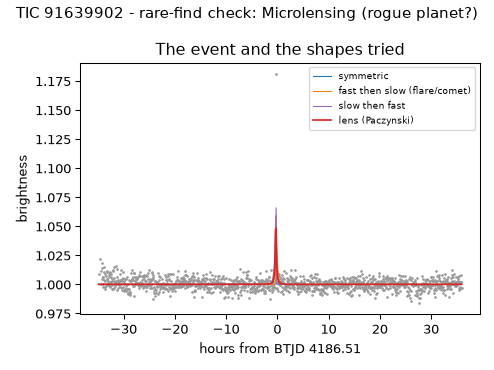
- Microlensing (rogue planet?) significant
A one-off, symmetric brightening at BTJD 4186.50 that fits the gravitational-lens shape better than a flare (Einstein time 0.7 h). Events this short can be made by a free-floating (rogue) planet passing in front of the star. Very rare in TESS data; scattered light and asteroids can mimic it.
Checked, nothing found (2)
Exocomet-shaped dip · Type of star
Checked 2026-10-11 17:11 on NVIDIA GeForce RTX 4070, using every TESS sector of this star. All results (.json)
Notes
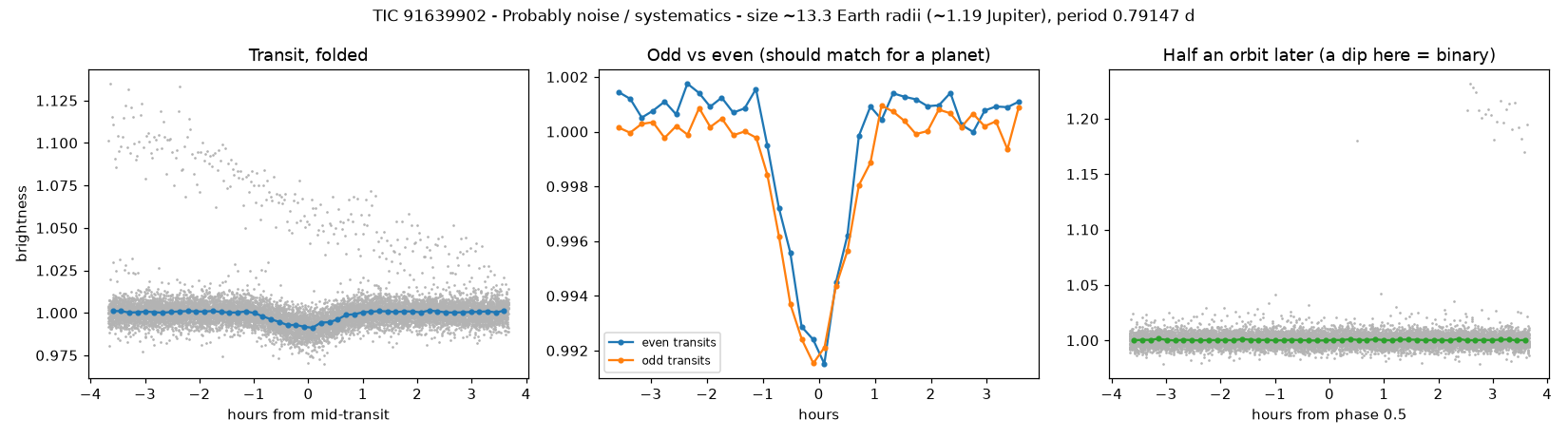
Probably noise or an instrument effect.
Rare, already known: Microlensing (rogue planet?) (the catalogued variable Gaia DR3 4951754317676601344 (E, 34" away) has the same period - its light leaks into TESS's big pixels; same period as the known variable Gaia DR3 4951754317676601344).
WARNING: same period as the known variable Gaia DR3 4951754317676601344 34" away; the signal is probably its light leaking in.
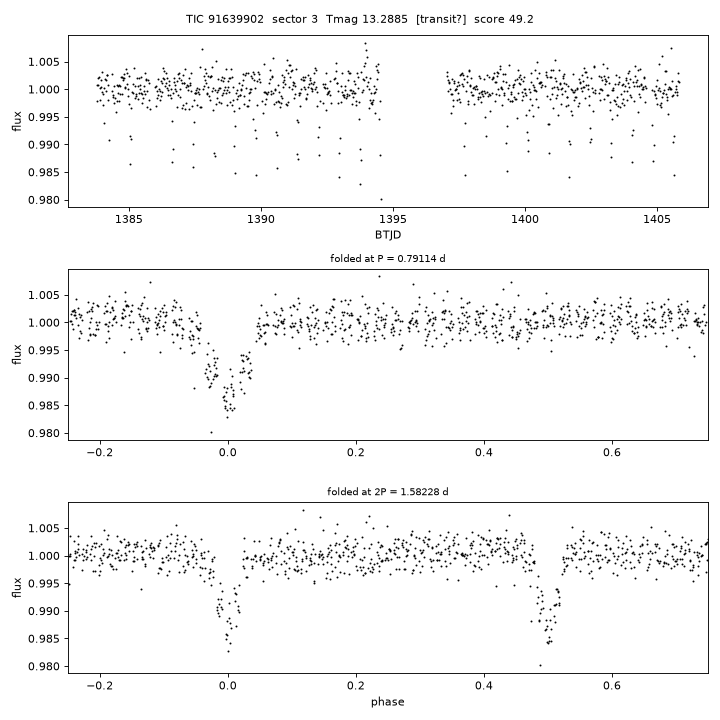
Found automatically by hunt.py in TESS sector 3 (flagged in 2 sector(s)). Detection score 49.2.
Not in VSX, ASAS-SN or ZTF variable catalogues at the time of the search; not in Gaia DR3's variable lists.
Unchecked by hand yet: verify the period, nearby stars and a wider catalogue search.
Updates:
2026-10-11 Rare-find check: Microlensing (rogue planet?)
2026-10-02 Planet check: Probably noise or an instrument effect
2026-10-02 Found by the automatic search in TESS sector 3
The signal
| Type | Transit candidate |
| Status | Rare, already known |
| Period (days) | 0.79114 |
| Period source | hunt.py on TESS QLP sector 3 |
| Eclipse / dip depth | 1.0% |
| Amplitude | 1.2% |
| Data used | TESS sector 3 (QLP) |
Planet check
| Verdict | Probably noise or an instrument effect |
| Size if it's a planet | ~13.3 Earth radii (~1.19 Jupiter) |
The star (Gaia & TESS)
| Distance (pc) | 975 (~3,179 light years) |
| Temperature (Gaia) | 6,595 K |
| Size (Gaia) | 1.30 x the Sun |
| Mass (Gaia) | 1.31 x the Sun |
| Luminosity (Gaia) | 2.90 x the Sun |
| Colour, Gaia BP-RP | 0.63 |
| RUWE (Gaia) | 0.99 - fits a single star |
| Gaia G mag | 13.60 |
| TESS mag | 13.29 |
Names & neighbours
| TIC ID | 91639902 |
| Gaia DR3 ID | 4951754317676600832 |
| SIMBAD name | not in SIMBAD |
| Nearest known variable | Gaia DR3 4951754317676601344 (E, P = 0.79147 d), 34" away (same period!) |
| RA (deg) | 39.9618 |
| Dec (deg) | -41.0649 |
| Look it up | SIMBAD · VSX · ESASky · ExoFOP |
Record
| Found by | hunt.py (automatic) |
| Date | 2026-10-02 |
| Last update | 2026-10-11 |
Where it sits among the stars
ESA Gaia colour and true brightness. Grey: every Star Log candidate. Orange: this star.
Data files
- 10_rare_check.png 32 KB
- 5_planet_check.png 101 KB
- TIC91639902_s0003.fits 82 KB
- TIC91639902_s0003.png 47 KB
- lightcurve_all_sectors.csv 1 MB
- planet_check.json 4 KB
- rare_check.json 2 KB
- thumb.png 69 KB
- meta.json